
Traders have moved billions of dollars from centralized exchanges to on-chain venues, and Hyperliquid leads that migration. The platform started as a small experiment and now competes with some of the largest names in crypto derivatives. This guide examines the Hyperliquid (HYPE) future scope through hard numbers, not slogans. We will review market share, revenue, token mechanics, and the rivals that keep pressure on the leader. We will also flag the risks that could break the bullish story. Readers who want more crypto research can browse the guides at Blockyr.
What Hyperliquid Is and How the HYPE Token Works
Hyperliquid runs its own layer-1 blockchain built for one job: perpetual futures trading. Perpetual contracts let traders bet on price moves without an expiry date, and they dominate crypto derivatives volume. Hyperliquid matches orders on a fully on-chain order book, so users keep custody of their funds while they trade. The HYPE token powers the network. Traders need it for gas, and validators stake it to secure the chain. The team also steers a large share of platform revenue toward token purchases, which links usage directly to token demand. This design explains why investors treat HYPE as a revenue-backed asset rather than a pure governance coin. The next section explains why traders actually choose this model.
Why Traders Choose On-Chain Order Books
Centralized exchanges ask users to trust them with deposits. Hyperliquid removes that requirement, and many traders value the change after high-profile exchange failures. The platform also publishes every trade and liquidation on-chain, so anyone can audit activity. Execution quality matters too. Analyst Arthur Hayes argued that order-book snapshots for Bitcoin perps showed Hyperliquid was usually the cheapest place to execute size once slippage was included. Cheap execution attracts professional traders, and professional traders bring deep liquidity. Deep liquidity then attracts more traders, which creates a flywheel. Still, convenience matters as much as principle. Centralized exchanges offer fiat onramps, customer support, and familiar apps. Hyperliquid must keep matching that experience if it wants mainstream users to follow. captureapp
The Market Share Evidence So Far
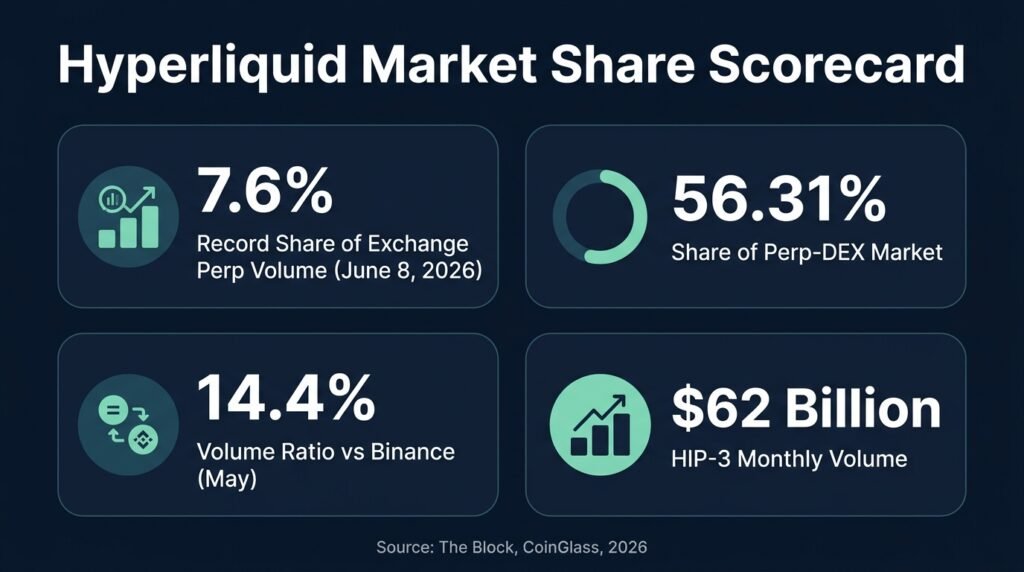
Numbers show real progress. According to The Block, Hyperliquid’s share of monthly perpetual volume against all centralized exchanges reached 6.63% in May, its highest point ever. A later analysis citing the same data reported a new record of 7.6% of all exchange perpetual volume on June 8, 2026, plus a perp-DEX share that more than doubled this year to 56.31%. A venue that held a tiny fraction of the market two years ago now influences global price discovery. These figures matter because they compare Hyperliquid with centralized giants, not only with other decentralized platforms. Rising share suggests that on-chain trading no longer serves only crypto purists. It serves ordinary derivatives traders who simply want better terms. theblockbuildix
Binance Still Towers Over Everyone
Context keeps the excitement in check. CoinGlass data showed that Binance processed about $4.9 trillion in derivatives volume in Q1 2026, roughly 35% of activity among the top 10 exchanges. Hyperliquid, meanwhile, entered the top 10 derivatives exchanges with $492.7 billion in volume. The gap remains enormous, even though Hyperliquid reached a record ratio of 14.4% against Binance in May. A trader should read that ratio as progress, not victory. Binance also benefits from fiat access, huge retail marketing, and a decade of brand trust. Hyperliquid cannot overtake it through volume alone. It must win on cost, transparency, and product variety. Our crypto exchange comparisons explain how those advantages play out for different trader types. Cointelegraphmexc
Revenue, Buybacks, and What Drives HYPE Demand
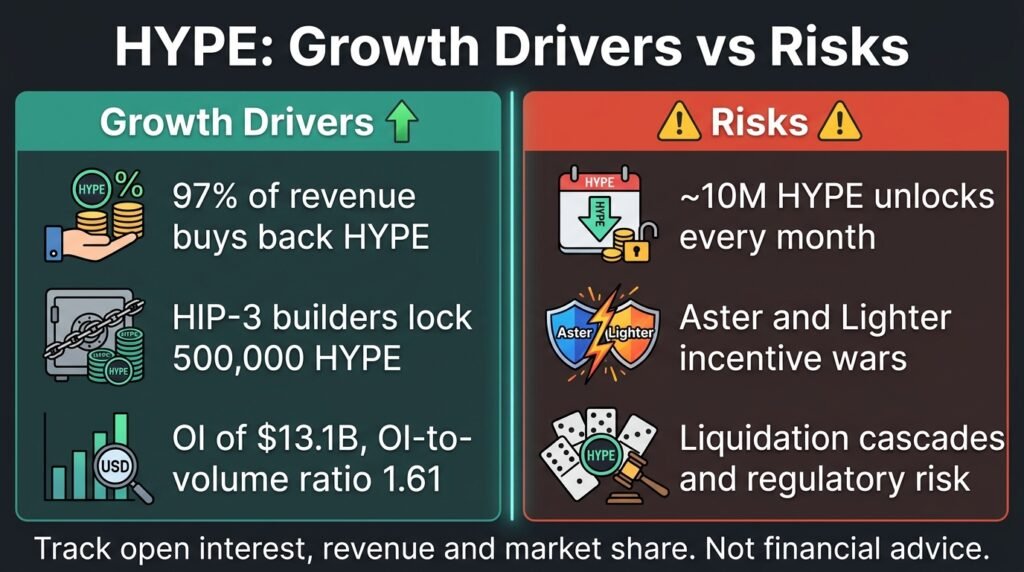
Revenue gives HYPE a clearer valuation story than most altcoins enjoy. VanEck reported that Hyperliquid historically routes 97% of all protocol revenue directly into purchasing HYPE tokens on the open market through its Assistance Fund. That mechanism turns trading fees into constant buy pressure. When volume rises, buybacks rise too. Hayes called Hyperliquid the largest revenue-generating project that isn’t a stablecoin. Supporters therefore compare HYPE with dividend-style assets, because the token captures real cash flow. Skeptics respond that buybacks depend entirely on continued trading activity. A slow market would weaken the flywheel immediately. Investors should track revenue each quarter and ask whether growth comes from sticky users or from temporary hype. vaneckcaptureapp
HIP-3 and the Push Into Tokenized Assets
HIP-3 may offer the strongest growth lever. This upgrade lets outside builders launch their own perpetual markets on Hyperliquid’s infrastructure. According to The Block, HIP-3 drove over $62 billion in volume and $3 billion in open interest. Builders must lock 500,000 HYPE in staking, and the deployer’s share of commissions stays fixed at 50%. That requirement removes HYPE from circulation and rewards builders who attract traders. Markets now cover commodities and tokenized traditional assets, not only crypto pairs. Traders who want oil or equity exposure can trade around the clock without a broker. This expansion could pull in users who never touched a crypto exchange. The same report warned that pure crypto volumes remain down significantly year over year. Hyperliquid hits record share of global perps market as HIP-3 tops $62 billion monthly volume +2
Rivals Fight Back: Aster, Lighter, and the Incentive Wars
Competition has grown fierce. Aster, backed by the Binance ecosystem, and Lighter, built by a team with traditional finance roots, both pursue Hyperliquid’s customers. DefiLlama noted that Aster briefly overtook Hyperliquid in reported daily volume during incentive-heavy periods. Lighter also posted huge numbers before its token launch, and Aster’s 70% peak market share collapsed to 15% by April 2026 once launch incentives normalized. That collapse teaches a clear lesson. Airdrop points and fee rebates can inflate volume temporarily, but they rarely build loyalty. Rivals will keep launching campaigns, and each one may steal short-term share. Hyperliquid must defend its position with product depth rather than bribes. You can follow the latest competitor launches through the news coverage at Blockyr. defillamablockeden
Why Open Interest Beats Raw Volume
Serious analysts look beyond headline volume. Blockworks reported in October that Hyperliquid holds over $13.1 billion in open interest and shows an OI-to-volume ratio of 1.61, while Lighter holds $1.37 billion in open interest with a ratio of 0.181. Open interest measures money that traders actually keep at risk. A low ratio often signals rapid in-and-out trading driven by farming. Blockworks separately observed that Lighter has slightly edged out Hyperliquid in weekly volume since mid-October, yet the open interest gap still favors Hyperliquid by a wide margin. This difference explains why many researchers still call Hyperliquid the quality leader. Investors should therefore watch open interest, revenue, and user retention before they trust any volume chart. blockworksblockworks
What Could Go Wrong With Hyperliquid
Every bullish thesis carries holes. First, competitors can erode share through subsidies, and the incentive wars have not ended. Second, leverage cuts both ways. Hyperliquid’s high open interest means sharp price moves can trigger large liquidation cascades, which may hurt users and damage trust. Third, the platform’s pure crypto volume has fallen compared with last year, so growth depends heavily on new markets like HIP-3. Fourth, regulators worldwide scrutinize unlicensed derivatives venues, and an enforcement action could limit access in major regions. Fifth, a small core team and a concentrated validator set raise governance questions. None of these risks guarantees failure. Together they remind investors that HYPE remains a high-volatility asset.
Token Unlocks, Regulation, and Concentration
Token supply deserves attention. VanEck noted that monthly unlocks of approximately 10 million HYPE began in November 2025, and the market has absorbed them so far. Absorption can change if demand cools, because new supply creates sell pressure. Regulation poses a second unknown. Lawmakers still debate how to treat decentralized derivatives, and rules could shift quickly. Concentration also matters. Hyperliquid dominates its niche, so any technical failure, bridge exploit, or outage would damage the whole ecosystem at once. Smart investors size positions with those scenarios in mind. They never allocate money they cannot afford to lose. For safer trading habits, read our risk management guides. vaneck
Can Perp DEXs Really Take Share From CEXs?
The evidence says yes, gradually, but not completely. Hyperliquid proves that an on-chain venue can handle serious volume, and its share of global perp trading keeps climbing. Transparency, self-custody, and cheap execution give it real advantages. Centralized exchanges still hold decisive strengths, including fiat access, insurance funds, and massive user bases. Most analysts expect a hybrid future where both models coexist and compete on price. Hyperliquid will likely keep gaining if it expands into new asset classes and protects its liquidity. A single bad incident, however, could reverse the trend overnight. The future scope looks promising, but investors should treat it as a growth bet with real risk. Stay updated through the research section at Blockyr.
Frequently Asked Questions (FAQs)
What share of global perp trading does Hyperliquid hold?
It reached a record 6.63% of centralized-exchange perp volume in May 2026, and later data showed about 7.6% in June.
Does Hyperliquid beat Binance in derivatives volume?
No. Binance still leads by a wide margin, although Hyperliquid reached 14.4% of Binance’s volume in May.
How does HYPE capture value?
The protocol sends most revenue to buy HYPE on the open market, and HIP-3 builders must lock 500,000 HYPE.
Who competes with Hyperliquid?
Aster and Lighter lead the challengers, and both use incentives to attract traders.
Is HYPE a safe investment?
No asset is safe. Leverage events, token unlocks, regulation, and competition can all hurt the price.
Final Thoughts
Hyperliquid has turned on-chain perpetuals from a niche idea into a credible rival for centralized exchanges. Its growing market share, buyback model, and HIP-3 expansion support a strong future scope. Competition, token unlocks, and regulatory uncertainty keep the outlook uncertain. Investors should follow open interest, revenue, and market share rather than short-term price swings. Make your own decision after careful research, and never risk more than you can lose. Continue learning with more analysis at Blockyr.