


The Binance hack shocked the crypto industry on Thursday, October 29, 2026. Attackers drained an estimated $6.3 billion from the world’s largest crypto exchange, making it the biggest crypto heist in history. Binance confirmed the breach, paused withdrawals, and promised to cover every loss. Meanwhile, blockchain investigators traced the stolen funds to North Korean hackers. Several industry partners moved fast to freeze billions of dollars. Bitcoin and Ether slid as traders absorbed the news. This article explains what we know so far about the Binance hack, how the attack worked, who investigators blame, and what it means for the market. Details continue to change, so Blockyr will track every major development.
What Happened in the Binance Hack
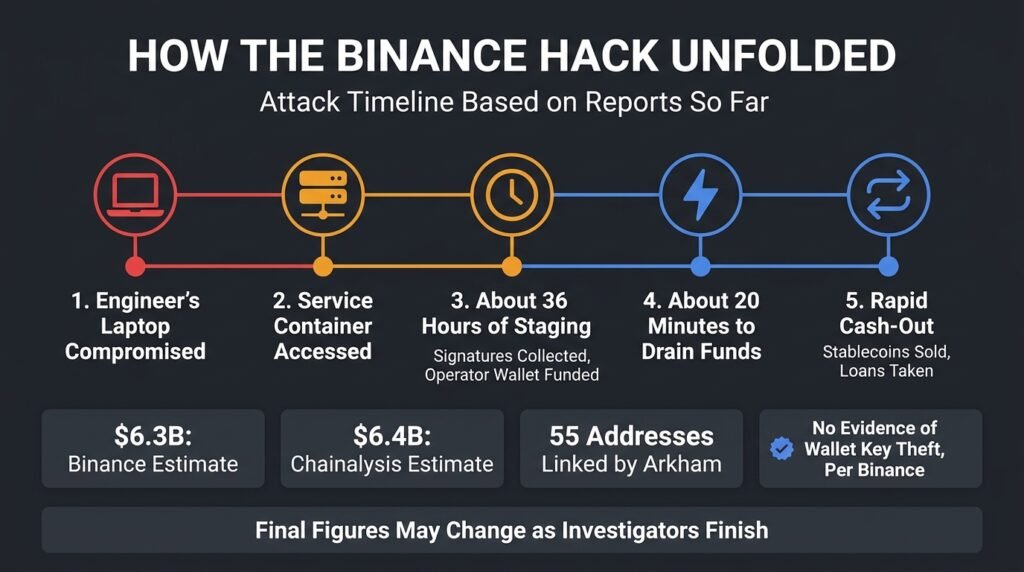
Hackers hit Binance on Thursday evening and sent unauthorized withdrawal transactions from the exchange’s systems. Binance later described $6.3 billion as an estimate of the impact, not a final confirmed theft figure. Chainalysis first put the damage at a minimum of $5.9 billion and then raised its estimate to $6.4 billion. Arkham, an analytics firm, linked nearly $6 billion in Bitcoin, Ether, Solana, and stablecoins to 55 addresses. Binance responded by suspending withdrawals and pausing trading on its Alpha platform, while deposits kept running normally. Co-founder Yi He told users that their funds remain safe and that the company will cover the losses. The scale stunned analysts. No attacker had ever taken so much from one platform in a single event, and the final figure may still change as investigators finish their work.
How the Binance Hack Unfolded
A Compromised Laptop Opened the Door
Binance traced the breach to a compromised laptop that belonged to one of its engineers. Early reports describe the employee as a DevOps engineer. The infected device gave attackers access to a service container, and from there they reached systems that approve withdrawals. Binance says it found no evidence that attackers stole the private keys of its wallets. Instead, they abused their access to trigger unauthorized transfers. The company has not explained how the attackers took over the laptop, and that question remains open. Security experts often see this pattern in modern attacks. Hackers target a single employee through phishing or fake recruiters, then move quietly through internal systems. One careless click can therefore expose even the largest platform. Binance promised a detailed technical analysis and an updated proof of reserves.
Attackers Drained Billions in Minutes
Speed defined this attack. TRM Labs says the attackers drained most of the money in about 20 minutes by using the exchange’s own signing system. Preparation, however, started much earlier. TRM found evidence that the group began staging the operation about 36 hours before the theft. The attackers funded an operator wallet with small Tornado Cash withdrawals and collected signatures in advance. Then they executed everything in one burst. After the drain, they rushed to cash out. They sold stablecoins, took loans against other stolen assets, and deposited 60 million USDT into Aave to borrow roughly $44.6 million in Wrapped Ether. Reports indicate these moves left the hackers with more than $2.4 billion in Ethereum and Bitcoin. Such fast laundering gave defenders very little time to react.
Who Is Behind the Binance Hack
Blockchain Analysts Point to North Korea
Two leading blockchain intelligence firms named the same suspect. TRM Labs attributed the Binance hack to TraderTraitor, a North Korean hacking group, and cited on-chain and off-chain intelligence. Chainalysis said it holds a high degree of confidence that North Korea carried out the attack. Investigators also saw the stolen funds mix with loot from the September Bitget hack, which cost that exchange hundreds of millions of dollars. These links strengthen the case. However, readers should note one key point. Private analytics firms made these attributions, and no formal government finding has appeared yet. President Donald Trump said US officials are probing a possible North Korean link. Until authorities publish their conclusions, the attribution remains a strong assessment rather than a final verdict.
Why TraderTraitor Targets Exchanges
North Korea has turned crypto theft into a major revenue stream. According to The Record, the country stole more than $2 billion in similar attacks last year, and US officials say the money helps fund Pyongyang’s weapons program. The group also stands behind the 2025 Bybit theft of about $1.5 billion, and the FBI attributed that attack within days. Exchanges hold enormous pooled funds, so one successful breach pays far more than thousands of small scams. Furthermore, Microsoft published research on Thursday showing that North Korean groups now use AI to build front companies and craft tailored phishing lures. That trend makes social engineering harder to spot and easier to scale. Exchanges therefore face a smarter and better-funded enemy than ever before.
Binance Hack vs. the Biggest Crypto Heists in History
The Binance hack dwarfs every earlier theft. It exceeds the Bybit breach by a factor of 4.2, according to Crypto Valley Journal, and it tops the combined losses of Bybit, Poly Network, and Ronin. Ronin lost roughly $540 million to $620 million in 2022, depending on the estimate. Poly Network lost about $600 million in 2021, though the attacker returned almost everything. Coincheck lost around $530 million in 2018. Mt. Gox remains a special case, because its 850,000 missing Bitcoin would be worth far more at today’s prices. Even with that caveat, nominal comparisons paint the same picture. No platform has ever lost this much in one event. Binance itself suffered a much smaller hack in 2019, when attackers took 7,000 Bitcoin worth about $40 million, and its SAFU fund covered that loss fully.
How Binance and the Industry Responded
Freezing Billions in Stolen Funds
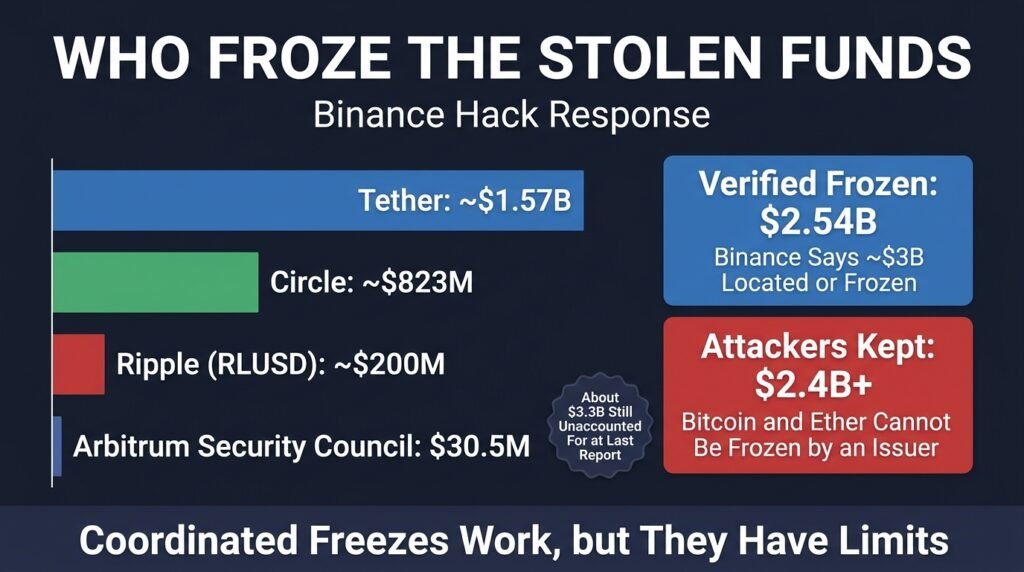
Speed saved part of the money. Binance says it has located or frozen around $3 billion, and it cited $2.54 billion as the verified frozen amount. Stablecoin issuers did most of the work because they can block individual addresses. Tether froze about $1.57 billion, and Circle froze about $823 million. Ripple stopped around $200 million in its RLUSD stablecoin, according to Yi He. In addition, the Arbitrum Security Council froze $30.5 million in ARB and ETH, and World Liberty Financial joined the effort. Even so, roughly $3.3 billion remained unaccounted for at the last report. Tokens like Bitcoin and Ether have no issuer who can freeze them, so the attackers kept more than $2.4 billion in those assets. This gap shows both the power and the limits of coordinated freezes.
Binance Promises to Cover All Losses
Binance moved to calm users within hours. Co-founder Yi He said user funds remain safe and that the company will absorb all hacking losses. The exchange plans to draw on its SAFU emergency fund and company reserves. It also revoked the authorization of the affected address, contacted law enforcement, and brought in blockchain analytics firms. Binance said it will revamp its withdrawal service and related addresses before it reopens withdrawals, and it expected that work to take about 48 hours. Deposits continue to operate normally. Moreover, the exchange promised an updated proof of reserves. Those steps matter because trust drives every exchange. Customers can forgive an attack, but they rarely forgive silence or delayed answers. So far, Binance has chosen to communicate quickly and publicly.
Market Impact of the Binance Hack
Crypto prices dropped as the news spread. Bitcoin fell to a six-week low and slipped below $77,000 in Asian trading on Friday. Ether slid to a two-month low. BNB, the token tied to the Binance ecosystem, fell much more sharply because its value depends heavily on the platform. Crypto-linked stocks, including Coinbase, Strategy, and Circle, also came under pressure in after-hours trading. Analysts at Standard Chartered said the incident could accelerate a shift toward decentralized exchanges. Decentralized platforms avoid holding customer funds in one corporate wallet, which explains that argument. However, they carry their own risks, such as smart contract bugs. Volatility may continue until Binance reopens withdrawals and investigators release more facts. Traders should therefore size positions carefully and avoid panic decisions.
What the Binance Hack Means for Crypto Security
Lessons for Exchanges
This incident exposes a hard truth. Strong cryptography does not help when attackers control an engineer’s laptop. Exchanges must treat every employee device as a possible entry point. They should isolate signing systems, require multiple independent approvals for large withdrawals, and monitor unusual transfers in real time. Rate limits on outgoing funds can also shrink the damage window, because attackers here drained most of the money within about 20 minutes. Furthermore, firms should train staff to spot AI-generated phishing and fake recruiter messages. Regulators will likely watch closely too, and readers can follow policy changes in Blockyr’s Blockchain Regulation coverage. Faster coordination between exchanges, stablecoin issuers, and analysts also proved valuable, and the industry should formalize it.
How Users Can Protect Their Assets
Individual users cannot stop a nation-state attack, but they can limit their exposure. First, avoid keeping all funds on one exchange. Second, move long-term holdings into a self-custody wallet and store the recovery phrase offline. Blockyr’s Crypto Wallets section covers storage options in detail. Third, enable strong two-factor authentication and use unique passwords everywhere. Fourth, watch for phishing messages that exploit the news, because scammers love moments like this. Finally, follow official updates from Binance instead of social media rumors. For more incident coverage, visit the Security & Hacks category, where Blockyr also covered a recent $320 million exploit. Smart habits cannot remove risk, but they reduce it sharply.
What Happens Next After the Binance Hack
Several questions remain open. Investigators still need to confirm the final loss figure, and Binance has promised a detailed technical report. Authorities may issue their own attribution, as the FBI did after the Bybit theft. Law enforcement and private firms will also keep tracing the roughly $2.4 billion in Bitcoin and Ether that moved through new wallets. Meanwhile, Binance must restore withdrawals and prove to users that it fixed the weakness. Regulators in the US and elsewhere may use the case to push for tougher custody rules. The industry will also reassess its dependence on centralized platforms. Blockyr will update readers as new facts emerge, so check the Bitcoin News category regularly for the latest reports.
Frequently Asked Questions (FAQs)
How much did the Binance hack cost?
Binance estimates the impact at $6.3 billion. Chainalysis later put the figure near $6.4 billion. Binance calls its number an estimate, so the final total may change as investigators complete their analysis.
Who carried out the Binance hack?
TRM Labs and Chainalysis both blame North Korea’s TraderTraitor group. These are private-firm assessments, and US officials say they are still investigating a possible North Korean link.
Are user funds safe on Binance?
Binance says user funds are safe and that it will cover all losses with SAFU and company funds. Deposits operate normally, while withdrawals wait for a security revamp of the withdrawal service.
How did the hackers break in?
Binance traced the breach to a compromised engineer’s laptop. That access let attackers reach systems that enable withdrawals. Binance says it found no evidence that private keys leaked.
How much stolen money did partners freeze?
Binance says about $3 billion is located or frozen, and it verified $2.54 billion. Tether, Circle, Ripple, and Arbitrum all froze funds. Billions remain unaccounted for.
Final Thoughts
The Binance hack sets a grim new record for crypto theft. Attackers used one compromised laptop to move billions, and analysts say North Korea’s TraderTraitor group likely stood behind it. Fast action from Tether, Circle, Ripple, and others froze roughly half of the loot, yet billions still sit with the attackers. Binance has promised to cover every loss, but it must now rebuild confidence through transparency and stronger security. Readers should stay calm, avoid rumors, and follow official updates. Moreover, they should review how they store their own assets today. Stay with Blockyr for continuing coverage as investigators reveal more about the biggest crypto heist in history.