



Bitcoin reclaims $81K on Wednesday, and traders now watch one event above everything else: the Federal Reserve’s rate decision. The market dipped below $80,000 on Monday for the first time in more than a week, and buyers pushed the price back up within two sessions. Every crypto trader now asks the same question. Does this bounce mark the bottom, or does it only offer a pause before another leg lower? The Fed announces its verdict at 2:00 PM ET, and Chair Kevin Warsh speaks at 2:30 PM ET. In this guide, we break down the price action, the macro backdrop, the key levels, and the scenarios that matter. For more market coverage, visit Blockyr.
Why Bitcoin Reclaims $81K Matters Right Now
Bitcoin reclaims $81K after a weekend slide that took the price close to $79,000. That level matters because it sits right on top of the 50-day exponential moving average, which many traders use as a trend filter. Buyers defended the zone, and the price rose about two percent in a single morning, according to CoinDesk’s live market coverage. Altcoins joined the move, and tokens such as HYPE, XRP, and DOGE posted gains. The bounce also erased most of Monday’s losses and calmed the panic that dominated social media. However, one green candle does not confirm a bottom. Traders still need follow-through, rising volume, and a calm reaction to the Fed before they trust this recovery.
What Happened to Bitcoin Before the Rebound
Bitcoin spent most of October inside a tight range between roughly $80,000 and $84,000. Early in the month, the price traded above $83,000, and then sellers pushed it lower in steady waves. Long liquidations hit leveraged traders hard, and spot ETF outflows removed a key source of demand. Monday’s drop below $80,000 shocked many holders who believed that level would hold. Then the market shifted. A strong rally in technology and chip stocks lifted risk appetite across Asia, and crypto followed that move higher. As a result, Bitcoin reclaims $81K without any single crypto-specific catalyst. Macro sentiment, not blockchain news, drove the entire swing.
How the Fed Decision Shapes the Bitcoin Outlook
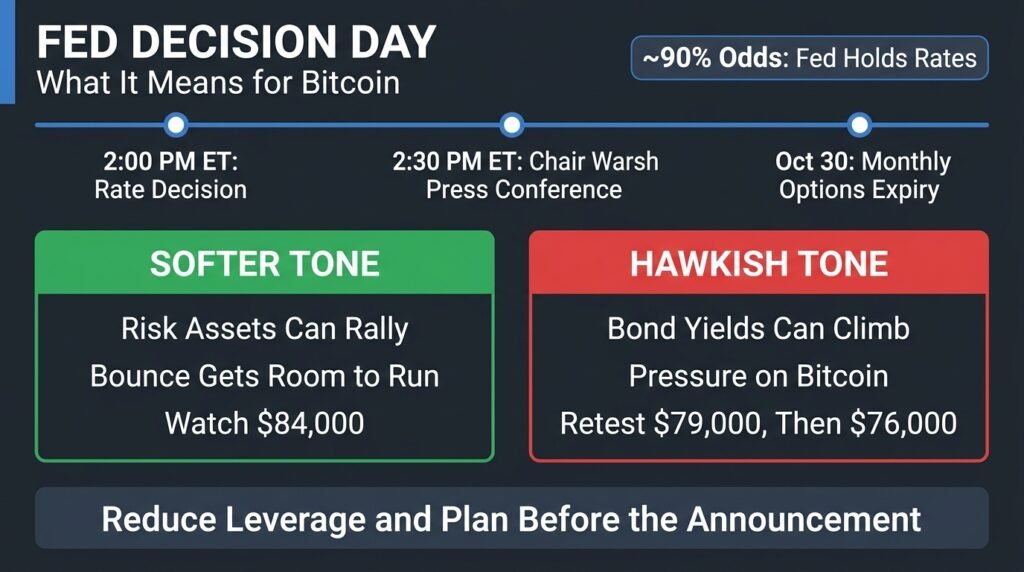
The Federal Open Market Committee meets on October 27 and 28, and the Federal Reserve’s official calendar confirms the schedule. Traders price roughly a 90 percent chance that the Fed holds rates steady. That expectation means a hold alone should not shock the market. The real risk sits in the language. The Fed raised rates in September for the first time since July 2023, and markets now debate whether another hike arrives in December. A hawkish tone could push Bitcoin back toward $79,000. A softer tone could give the current bounce room to run. Therefore, the press conference may matter more than the decision itself.
Why Warsh’s Press Conference Could Move the Market
Kevin Warsh leads the Fed, and he faces his first major test of credibility with a restless crypto market. Traders will parse every sentence for hints about a December hike. If Warsh calls the September move a one-time adjustment, risk assets could rally. If he describes inflation as stubborn, bond yields could climb and pressure Bitcoin. Historically, Bitcoin moves about one percent in the first hour after an FOMC release, roughly double a normal hour. That statistic shows how sensitive the market becomes around these events. Smart traders keep position sizes modest and avoid heavy leverage until the dust settles. Volatility often spikes first and reveals the true direction later.
Key Support Levels Bitcoin Bulls Must Defend
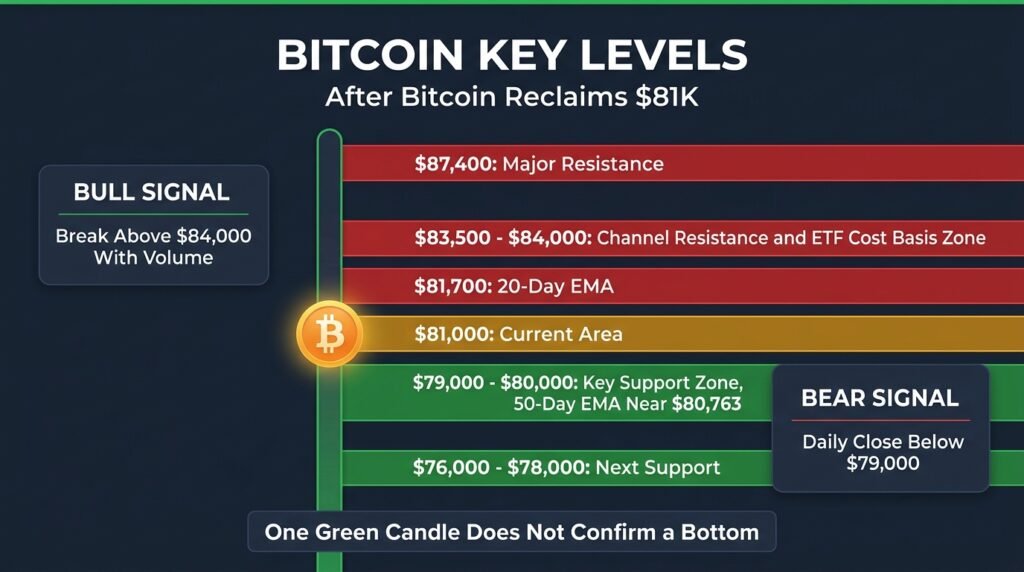
Bitcoin bulls must defend the $79,000 to $80,000 zone first. This area caught the weekend selloff, and buyers have shown up there repeatedly. The 50-day exponential moving average near $80,763 adds extra weight to that floor. If sellers break below $79,000, the next support zone sits between $76,000 and $78,000. A drop into that range would likely trigger more long liquidations and test the patience of newer holders. Analyst Daan Crypto Trades describes the market as “another day sitting at the $80K support,” and neither side can seize control. Consequently, a daily close below $79,000 would weaken the bottom thesis significantly.
Resistance Levels That Could Cap the Rally
Bitcoin faces its first real hurdle near $81,700, where the 20-day exponential moving average sits. Above that, the channel resistance between $83,500 and $84,000 will test the bulls again. This zone also lines up with the average cost basis of spot ETF investors near $84,300. Many holders who bought there wait to break even, and they often sell into strength. A clean break above $84,000 would shift the short-term structure and open the road toward $87,400. That level marks the major resistance from the last rally. Until buyers clear those ceilings, the market still trades inside a descending pattern with lower highs.
ETF Flows and Institutional Demand
Spot Bitcoin ETFs act as a barometer for institutional appetite. On October 19, these funds recorded a net inflow of about $527 million, which showed strong spot demand. Later in the week, outflows returned and weighed on sentiment. That swing explains why price stalled below the ETF cost basis. Institutional buyers usually accumulate during quiet periods and step aside during macro uncertainty. If inflows return after the Fed meeting, Bitcoin could break its range with real conviction. If outflows continue, the market will likely drift lower. Therefore, watch daily ETF flow data closely over the next five sessions.
Derivatives Data: Are Leveraged Traders Shaking Out?
Derivatives data offers important clues about whether a bottom forms. Open interest in Bitcoin futures recently rebounded to about 645,000 BTC, and funding rates normalized after weeks of stress. Normal funding means traders no longer pay a heavy premium to hold long positions. The recent liquidation events also cleared many overleveraged traders from the market. Historically, such flushes often precede stronger recoveries because weak hands leave first. Options data shows a large cluster of monthly contracts expiring on October 30, and that expiry could add volatility right after the Fed. As a result, price swings may stay sharp through the end of the week.
Macro Risks Beyond the Fed
The Fed does not act alone on Bitcoin’s direction. Oil prices stay above $110 per barrel because of tension in the Middle East, and that pressure keeps inflation worries alive. Higher inflation gives the Fed more reason to stay hawkish, which hurts risk assets. Tech earnings also arrive this week, and strong results could extend the equity rally into crypto. Meanwhile, the U.S. midterm elections add political uncertainty. Bitcoin now trades more like a high-beta risk asset than a pure inflation hedge. Therefore, traders must watch stocks, oil, and bond yields alongside the Bitcoin chart.
Is the Bitcoin Bottom In? The Bull Case
Bulls argue that Bitcoin reclaims $81K for a good reason. The price held its range support, and sentiment sits at neutral rather than extreme fear. Galaxy Digital says the market now looks like an accumulation phase, and long-term holders keep adding coins. Roughly 145,000 BTC changed hands near the $82,000 cost range, which suggests steady demand from new buyers. If the Fed holds rates and softens its tone, Bitcoin could break $84,000 quickly. That move would invalidate the descending channel and confirm a higher low. Under this scenario, October’s dip becomes a classic shakeout before a stronger November.
Is the Bitcoin Bottom In? The Bear Case
Bears point out that Bitcoin still trades below its major trend lines, and the recent bounce lacks strong volume. The price also trades roughly 37 percent below its 2025 peak, and October looks set to post a loss of about three percent. That would mark the second straight year of October declines. A hawkish Warsh could trigger a quick retest of $79,000 and then $76,000. ETF outflows and high oil prices would add further pressure. Under this scenario, today’s bounce simply gives sellers a better price to exit. Honest traders accept that both outcomes remain possible.
How Traders Can Prepare for the Fed Decision
Preparation beats prediction in volatile weeks like this one. First, reduce leverage so a sudden wick does not liquidate your position. Second, scale into entries in small portions instead of buying everything at one price. Third, set clear invalidation levels, such as a daily close below $79,000. Fourth, avoid trading during the first few minutes of the press conference, when spreads widen and fake moves appear. Finally, write down your plan before the announcement so emotion cannot change it. Disciplined traders survive volatility, and they often profit from it after the noise fades.
Frequently Asked Questions (FAQs)
1. Why does Bitcoin reclaim $81K before the Fed decision?
A rally in tech and chip stocks lifted risk appetite, and traders bought the dip near $79,000. Positioning ahead of the Fed also played a role.
2. What does the market expect from the Fed today?
Traders price about a 90 percent chance that the Fed holds rates steady. The market focuses mainly on whether Warsh signals a December rate hike.
3. What are the key Bitcoin support and resistance levels?
Support sits near $79,000 and then $76,000 to $78,000. Resistance starts near $81,700, then $83,500 to $84,000, and finally $87,400.
4. Does the Fed decision always move Bitcoin?
Not always. Surprises and tone move the market more than the rate itself. Bitcoin usually moves about one percent in the first hour after an FOMC release.
5. Is it safe to buy Bitcoin right now?
No one can guarantee safety. Many traders use staggered entries, small positions, and low leverage during event weeks. This article does not offer financial advice, so research carefully before you invest.
Final Thoughts
Bitcoin reclaims $81K at a critical moment, but the bottom remains unconfirmed. The bounce shows that buyers still defend the $79,000 to $80,000 zone, and sentiment has cooled from extreme fear. However, the market needs more proof. A break above $84,000 with strong volume would signal real strength, while a close below $79,000 would challenge the bottom thesis. The Fed decision and Warsh’s tone will likely set the direction for the rest of the week. Stay patient, manage risk, and let the price confirm the trend. For more crypto updates and analysis, keep following Blockyr, and read CoinCentral’s market report for additional context.