

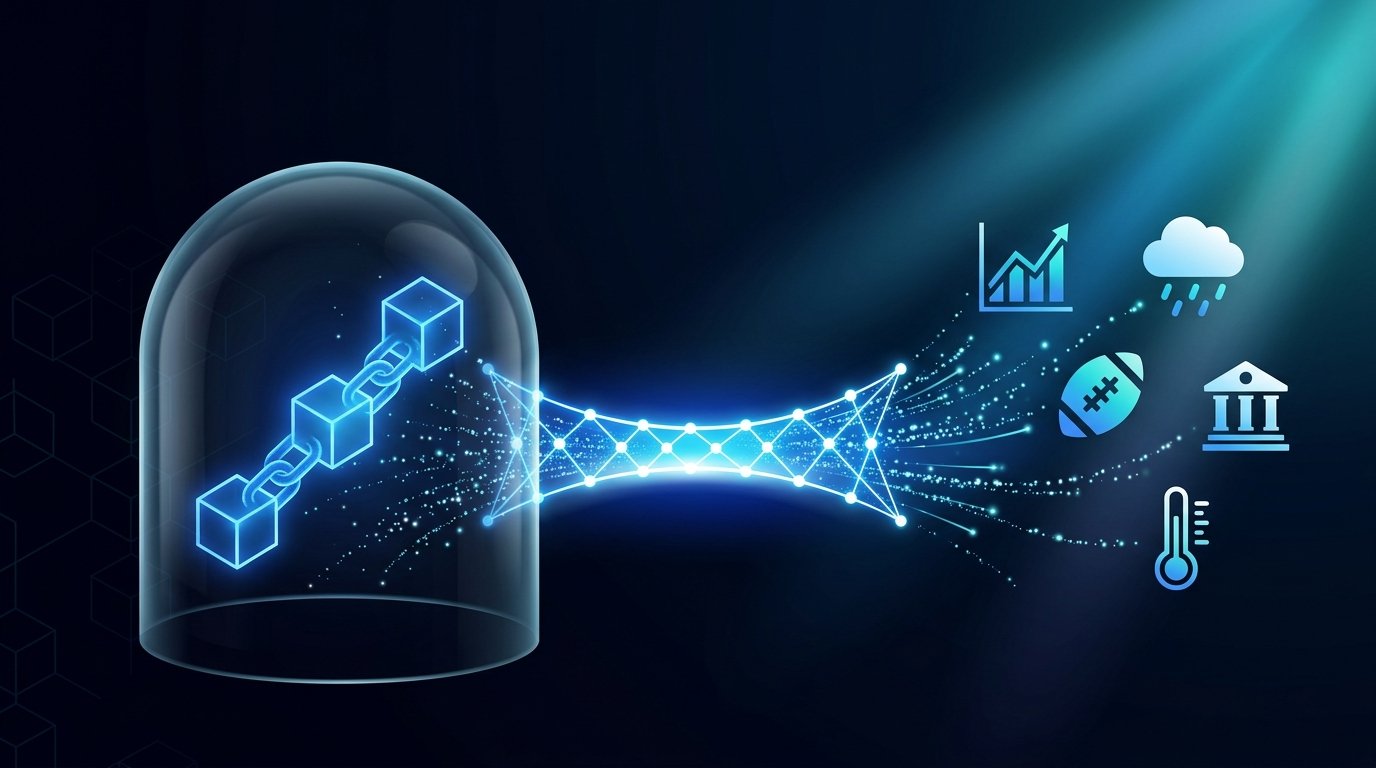
Smart contracts run perfectly on their own, but they cannot see the outside world. So, what is Chainlink, and why does the crypto industry rely on it so heavily? Chainlink is a decentralized oracle network that delivers real-world data to blockchains. It lets smart contracts read prices, weather reports, sports scores, and bank data without trusting a single source. The network’s native token, LINK, pays node operators and secures the system. In this guide, you will learn how Chainlink works, what services it offers, and which risks you should watch. You can also explore more beginner-friendly crypto guides on Blockyr. Let us start with the basics.
What Is Chainlink and Who Created It?
- Sergey Nazarov and Steve Ellis co-founded Chainlink and published its whitepaper in 2017.
- The project launched on Ethereum, but it now works across many blockchains.
- Chainlink acts as middleware between blockchains and outside data.
- Independent node operators fetch data, check it, and send it on-chain.
- The network does not create its own blockchain for payments.
- Developers use it as a toolkit to build secure, data-driven applications.
- LINK serves as the token that rewards operators and backs the network’s security.
- Many major DeFi platforms use Chainlink to price their assets.
- Banks and asset managers also test it for tokenized assets and cross-border messaging.
Chainlink focuses on one big problem: connecting two separate worlds. Blockchains hold trusted but isolated data. Chainlink gives them a safe bridge to everything else.
Why Do Blockchains Need Oracles?
Blockchains work like sealed rooms. Every node inside the room agrees on the same records, and no outsider can change them. That design creates strong security, but it also blocks access to outside information. A blockchain cannot check a stock price, a flight delay, or the temperature in Karachi by itself.
- Crypto experts call this limitation the “oracle problem.”
- A smart contract that insures crops needs rainfall data.
- A lending protocol needs fair, live asset prices.
- A betting app needs real match results.
- A single data source creates a single point of failure.
- A hacked source can drain millions from a protocol.
- Developers need many sources and many checkers.
An oracle solves this problem by carrying outside data onto the chain. A centralized oracle brings back the very trust issue that blockchains try to remove. A decentralized oracle network like Chainlink spreads that trust across many independent participants.
How Do Chainlink Oracles Work?
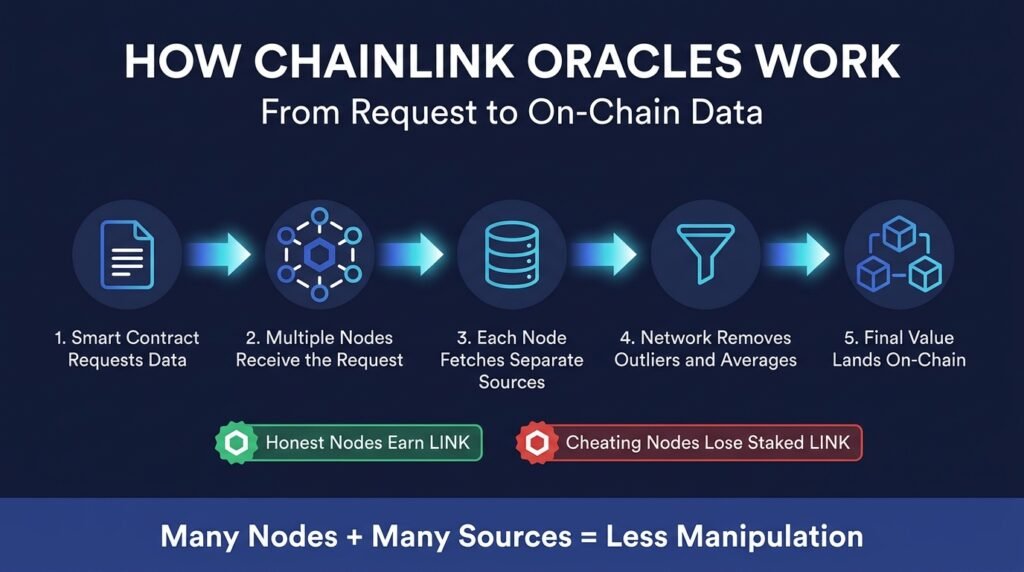
Chainlink uses a network of independent node operators instead of one data provider. Each node pulls information from premium data aggregators and public sources. Then the nodes compare their results and reach a consensus. The network aggregates the answers and publishes one final value on-chain. Smart contracts read that value and act on it automatically.
- A developer requests data through a smart contract.
- Multiple nodes receive the request.
- Each node fetches data from separate sources.
- The network removes outliers and averages the valid answers.
- The final result lands on the blockchain.
- Node operators earn LINK for honest work.
- Operators who cheat or fail risk losing their staked tokens.
This process reduces manipulation because an attacker would need to corrupt many nodes and many sources at once. Chainlink also uses cryptographic proofs and reputation systems to track node performance. As a result, developers can choose high-quality nodes for sensitive applications.
What Services Does the Chainlink Network Offer?
Chainlink has grown far beyond simple price feeds. Today, the network offers a full suite of tools for builders. You can read the full list in the official Chainlink documentation.
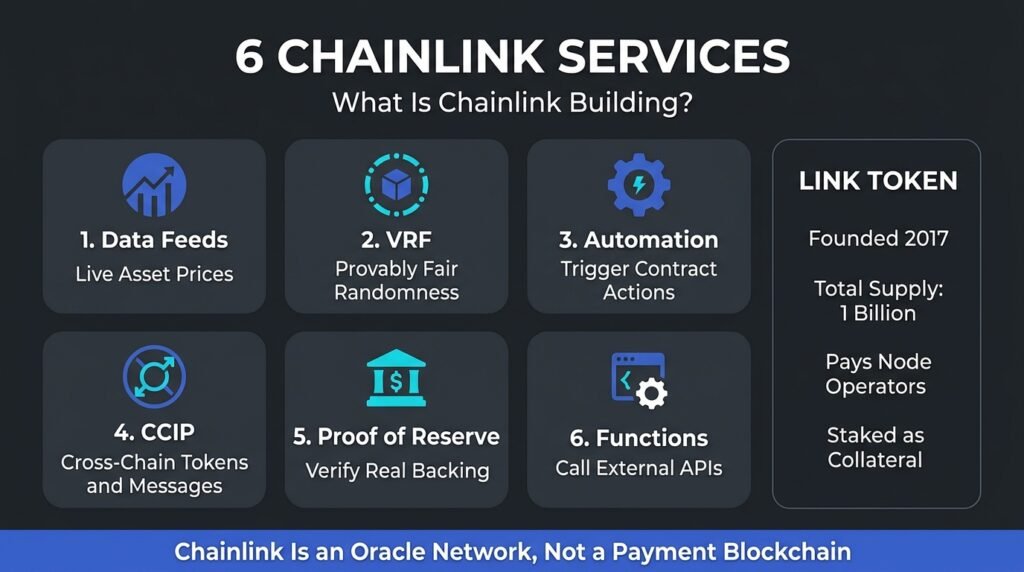
- Data Feeds: These deliver live asset prices to DeFi apps and update automatically.
- Verifiable Random Function (VRF): This service produces provably fair random numbers for games, NFTs, and lotteries.
- Automation: This tool triggers smart contract actions on a schedule or after a condition changes.
- Cross-Chain Interoperability Protocol (CCIP): This protocol moves tokens and messages between different blockchains.
- Proof of Reserve: This feature verifies that a token’s backing assets really exist.
- Functions: This service lets contracts call external APIs and run custom code off-chain.
Each service solves a different problem, yet all of them rely on the same decentralized security model. Developers can mix several services inside one application. For example, a game can use VRF for random loot and Automation for daily rewards.
What Role Does the LINK Token Play?
LINK is the utility token that powers the Chainlink ecosystem. Users pay node operators in LINK when they request data or services. This payment gives operators a clear reason to deliver accurate results. Operators also stake LINK as collateral, which discourages bad behavior.
- LINK follows the ERC-677 standard, which extends Ethereum’s ERC-20 token.
- The total supply stands at one billion tokens.
- Staking lets holders help secure the network and earn rewards.
- Node operators receive LINK for each completed job.
- Slashing penalties punish dishonest or unreliable nodes.
- The token’s demand grows when more applications use Chainlink.
- Traders also buy LINK on major exchanges for speculation.
Remember that token price depends on market sentiment as well as network usage. Therefore, always separate Chainlink’s technology from LINK’s short-term price moves. Check live market data before you make any decision.
Real-World Use Cases of Chainlink
Chainlink already supports a wide range of industries. Its strongest adoption appears in decentralized finance, but other sectors are catching up.
- DeFi lending: Platforms use price feeds to decide when to liquidate loans.
- Stablecoins: Issuers use Proof of Reserve to show real backing.
- Insurance: Parametric policies pay out automatically when weather data hits a trigger.
- Gaming and NFTs: Developers use VRF to guarantee fair drops and random rewards.
- Tokenized assets: Asset managers use CCIP to move tokenized funds across chains.
- Supply chains: Companies track shipments with sensor data on-chain.
- Banking pilots: Financial institutions test cross-border messaging with blockchain networks.
These examples show one pattern. Whenever a smart contract needs trusted outside information, Chainlink often supplies it. That demand keeps the network relevant even when crypto markets slow down.
What Are the Risks and Challenges for Chainlink?
No project is perfect, and Chainlink faces real challenges. Smart investors and builders should understand them before they commit time or money.
- Competitors such as Pyth Network and API3 fight for the same market.
- Some critics argue that node operators remain too concentrated.
- Smart contract bugs can still harm apps that use Chainlink data.
- Regulation of crypto and tokenized assets keeps changing worldwide.
- Large token unlocks can pressure the LINK price.
- Data quality depends on the sources that nodes query.
- Network upgrades add complexity, so teams must audit them carefully.
Chainlink continues to expand its node set and improve its security design. Even so, no oracle can promise zero risk. Diversify your research, read audits, and never invest more than you can afford to lose.
What Is the Future of Chainlink and Oracle Technology?
Oracle networks will likely grow as blockchains move into traditional finance. Tokenized stocks, bonds, and real estate all need reliable off-chain data. Chainlink positions itself as a core layer for that shift. Its cross-chain tools aim to connect many separate networks into one connected system.
- Banks keep testing tokenization with blockchain infrastructure.
- Cross-chain apps need safe messaging between networks.
- AI agents may soon request verified data through oracles.
- Staking upgrades could strengthen network security further.
- New competitors will push Chainlink to keep improving.
- Developers will keep choosing proven tools for high-value apps.
- Clearer regulation could speed up institutional adoption.
You can follow official updates directly on the Chainlink website. For a broader technical background, the Ethereum oracle guide explains why oracles matter. For more crypto education, keep reading Blockyr.
Frequently Asked Questions (FAQs)
1. What is Chainlink in simple words?
Chainlink is a decentralized network that brings outside data to blockchains. Smart contracts use this data to make decisions, such as paying an insurance claim or liquidating a loan.
2. Is Chainlink a blockchain?
No. Chainlink works as an oracle network that sits on top of existing blockchains. It does not run its own payment chain.
3. What does the LINK token do?
LINK pays node operators for their services. Operators also stake it as collateral, which keeps them honest.
4. Who created Chainlink?
Sergey Nazarov and Steve Ellis co-founded the project and released the whitepaper in 2017.
5. Is Chainlink a good investment?
Nobody can promise returns. Chainlink has strong real-world adoption, but LINK’s price still moves with the wider crypto market. Research carefully and consult a licensed advisor.
Conclusion
So, what is Chainlink in the end? It is the data bridge that lets smart contracts see and react to the real world. Its decentralized oracle network, wide service list, and strong DeFi adoption make it one of the most important infrastructure projects in crypto. LINK secures that system by rewarding honest nodes and punishing bad ones. However, competition, regulation, and market swings still create risk. Study the technology first, and then decide how it fits your own plans. Visit Blockyr for clearer, practical crypto guides.