

Binance delists cryptocurrencies on a regular schedule, and every announcement can erase a token’s value within hours. Millions of traders use the world’s largest exchange, so a delisting notice cuts liquidity, shakes confidence, and often triggers a sharp price crash. Many investors buy altcoins without asking whether the project can pass an exchange review. That mistake costs them real money. This guide explains why Binance removes tokens, which warning signs appear before a delisting, and which checks you should run before you buy any altcoin. You can also explore more market guides on Blockyr to get knowledge about the binance delist cryptocurrncies.
What is the meaning of Binance Delist Cryptocurrencies?
A delisting means Binance removes a token’s trading pairs from its platform. After the removal date, users cannot buy or sell that coin on the exchange. Binance usually posts a notice several days in advance, which gives holders time to react. The exchange lists the exact date, the affected pairs, and the final withdrawal deadline. Most holders then rush to sell, and that rush pushes the price down fast. Some projects recover by moving to smaller exchanges, but many lose most of their trading activity for good. Delisting does not mean the blockchain stops working. It means the biggest liquidity source closes its doors to that token.
- Binance removes the trading pairs on a set date.
- Users keep the right to withdraw their coins after delisting.
- Open orders cancel automatically when trading stops.
- Price usually drops sharply after the announcement.
Why Does Binance Delist Cryptocurrencies?
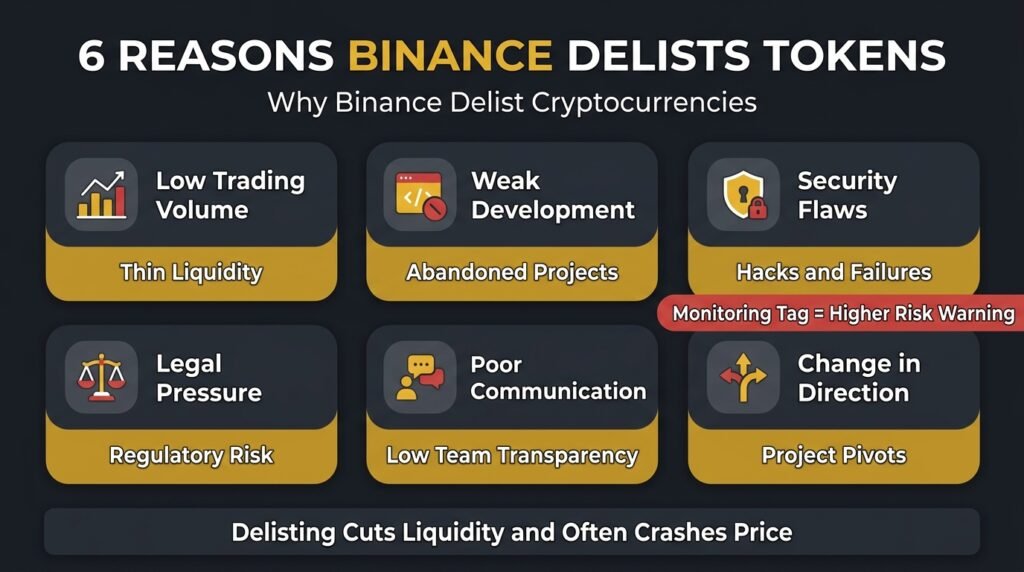
Binance reviews every listed token on a continuous basis, and the exchange removes projects that no longer meet its standards. The company states that it protects users by dropping assets that carry too much risk. Its team checks trading activity, development progress, network security, and legal standing. When a project fails one or more of these tests, Binance may apply a monitoring tag first and then proceed to delisting. This process does not target any single project unfairly. It applies the same rules to everyone, from small meme coins to older altcoins with large communities. Understanding these rules helps you spot weak projects before the exchange does.
- Weak trading volume and thin liquidity
- Abandoned or slow development
- Security flaws and technical failures
- Legal and regulatory pressure
- Poor communication from the project team
- Changes in the project’s overall direction
Low Trading Volume and Weak Liquidity
Liquidity decides whether traders can buy and sell a coin without moving its price. When a token attracts few buyers, spreads widen and small orders cause big price swings. Binance monitors trading volume closely, and tokens that stay quiet for months often land on the delisting list. A thin market also invites price manipulation, because a single large trader can push the price in either direction. Binance wants healthy markets for its users, so it removes tokens that fail to attract steady demand. You can check a coin’s 24-hour volume on CoinMarketCap in seconds. If the volume looks tiny compared with the market cap, treat that gap as a serious warning.
- Check the daily volume against the market cap.
- Watch for sudden volume spikes without news.
- Avoid coins that trade on only one or two exchanges.
Weak Development Activity and Abandoned Projects Cause Binance delist cryptocurrencies
A healthy crypto project ships updates, fixes bugs, and improves its product over time. Developers who stop working leave the network exposed to errors and security risks. Binance reviews whether teams still maintain their code and meet their roadmap promises. When a project goes silent for months, the exchange treats that silence as a red flag. Investors can verify development activity on GitHub by checking the number of recent commits and active contributors. A project with a flashy website but an empty code repository deserves extra suspicion. Teams that care about their users publish regular progress reports, and they answer questions from the community without delay.
- Look at the GitHub commit history from the last six months.
- Read the roadmap and compare it with delivered milestones.
- Notice whether developers answer community questions.
Security Flaws and Technical Failures
Security problems destroy trust faster than any other issue. If hackers exploit a smart contract or attack a blockchain, Binance may suspend deposits and withdrawals immediately. Repeated network outages, unfixed bugs, and failed upgrades also push the exchange toward delisting. Binance cannot risk its users’ funds, so it acts quickly when a project shows weak defenses. Before you buy any altcoin, search for past hacks, exploits, and audit reports. A reputable audit from a known security firm gives you extra confidence, although it does not guarantee safety. Projects that hide their audit results or skip audits entirely ask you to trust them blindly, and that approach rarely ends well.
- Search the token’s name together with “hack” or “exploit.”
- Read the public audit report before investing.
- Check whether the team fixed past problems quickly.
Regulatory and Legal Pressure
Governments and regulators keep tightening their rules around crypto assets. When a regulator labels a token an unregistered security or links it to illegal activity, Binance may remove it to protect itself and its users. Privacy coins often face this pressure because authorities struggle to trace their transactions. Legal trouble for a project’s founders can also trigger a review. Binance operates in many countries, so it must follow the strictest rules that apply to its business. Investors should follow regulatory news about any coin they hold. You can read the latest policy updates and market reports on Blockyr to stay ahead of sudden announcements.
- Track lawsuits involving the project or its founders.
- Follow regulator statements about the token’s category.
- Understand that privacy-focused coins face higher delisting risk.
Poor Communication and Team Transparency
Binance expects project teams to communicate honestly and regularly. Teams that hide their identity, ignore user questions, or mislead the community lose the exchange’s confidence. Binance also asks projects to respond to its own requests for information, and teams that refuse to cooperate risk removal. Transparency shows up in simple habits: clear tokenomics, public wallet addresses, and honest updates about problems. When a founder disappears from social media and the official channels go silent, investors should take that as a major warning. Strong teams explain bad news openly, because they understand that honesty protects their long-term reputation with exchanges and users alike.
- Confirm that the team members use real, verifiable identities.
- Review how the project handles criticism and bad news.
- Watch for deleted posts or sudden changes to official channels.
How the Binance Monitoring Tag Works
Binance often warns users before it delists a token. The exchange applies a monitoring tag to assets that show higher risk and deserve extra caution. The tag appears next to the coin’s name, and it tells traders that the project may fail a future review. Binance also requires users to read a risk warning before they trade tagged assets. A tag does not guarantee delisting, because some projects fix their problems and earn the tag’s removal. However, many tagged coins eventually leave the platform. If you hold a tagged coin, review your position immediately and decide whether the risk still fits your plan. You can follow official updates on the Binance announcement page.
- A monitoring tag signals higher risk, not certain removal.
- Tagged coins often lose liquidity quickly.
- Binance announces tag changes on its official channels.
Warning Signs Every Investor Should Check Before Buying Altcoins
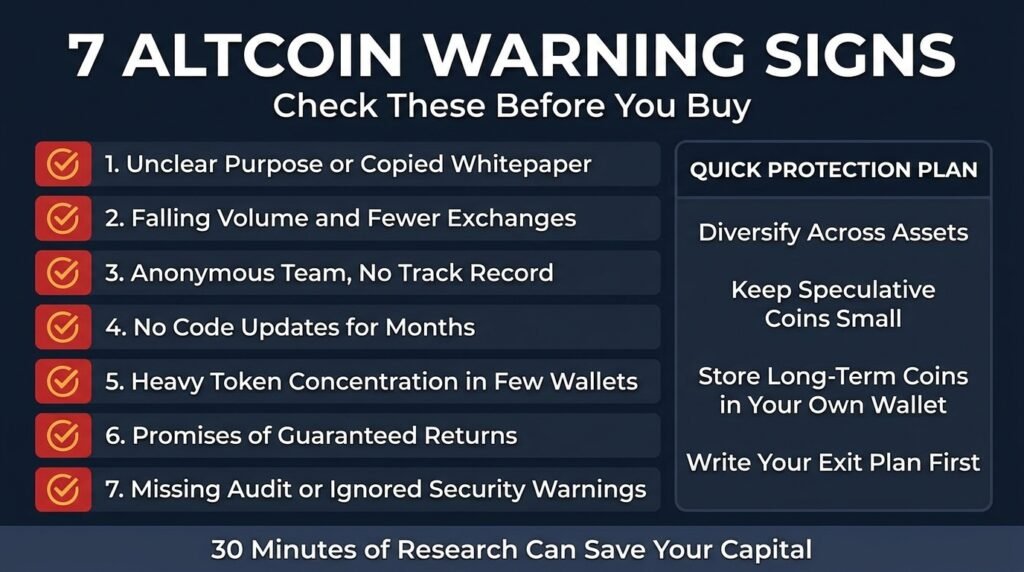
You can lower your delisting risk with a short research routine. Start by studying the project’s purpose, because a coin without a clear use case struggles to keep users. Next, check the token’s liquidity, the number of exchanges that list it, and the trend in its trading volume. Review the team, the code activity, and the audit history. Then look at the tokenomics, since heavy insider ownership allows a few wallets to dump on regular buyers. Finally, read independent opinions and compare them with the project’s own claims. Investors who spend thirty minutes on these steps avoid many painful losses, and they build better habits for every future trade.
- Unclear purpose or copied whitepaper
- Falling volume and shrinking exchange support
- Anonymous team with no track record
- No code updates for several months
- Heavy token concentration in a few wallets
- Aggressive promises of guaranteed returns
- Missing audit or ignored security warnings
How to Protect Your Portfolio From Binance Delist Cryptocurrencies
Smart risk management protects your money even when you pick a weak project. Spread your funds across several assets instead of betting everything on one altcoin. Keep the biggest share of your portfolio in stronger, established coins, and limit speculative tokens to a small percentage. Set a regular schedule to review every position you hold. Follow the exchange’s official announcements so you never miss a delisting notice. Use a personal wallet for long-term holdings, because it gives you control over your coins regardless of any exchange decision. Finally, decide your exit rules before you buy, since emotional decisions during a crash usually make losses bigger.
- Diversify across different sectors and market sizes.
- Limit each speculative coin to a small slice of your portfolio.
- Store long-term holdings in a wallet you control.
- Write down your exit plan before you invest.
What to Do If Binance Delists Your Coin
Stay calm when you see the notice, because you still have options. First, read the announcement carefully and note the final trading date and the withdrawal deadline. Next, decide whether you want to sell on Binance, move the coins to another exchange, or transfer them to a private wallet. Check where else the token trades before you move it, because some exchanges list it with poor liquidity. Never send coins to an address you have not verified, and watch out for scammers who impersonate support staff during delisting periods. If you plan to hold, research the project’s future carefully, since a delisted coin often struggles to regain momentum.
- Note the trading end date and the withdrawal deadline.
- Compare liquidity on other exchanges before you transfer.
- Ignore private messages that offer “rescue” services.
FAQs On Binance Delisted Cryptocurrencies
Can a delisted coin come back to Binance?
Yes, but it rarely happens. A project must fix the problems that caused its removal and then pass a new review. Most teams never complete that process.
Do I lose my coins when Binance delists them?
No. You keep ownership of your coins and can withdraw them before or after the deadline. You only lose the ability to trade them on Binance on delist cryptocurrencies.
Does every delisting of cryptocurrency on bianance mean the project is a scam?
No. Some projects fail because of low demand or slow growth, not fraud. Still, a delisting always signals that the project faces serious problems.
Conclusion About Binance Dilisted Cryptocurrencies
When Binance delists cryptocurrencies, the decision usually follows clear patterns: weak liquidity, stalled development, security failures, legal trouble, and poor transparency. You can spot most of these problems early if you research before you buy and review your holdings often. Diversify your portfolio, follow official announcements, and keep your long-term coins in a wallet you control. Careful research takes a little time, but it protects your capital far better than hype ever will. For more guides that help you trade with confidence, visit Blockyr and search about the binance delist cryptocurrencies.