


Search “mexico payments news” on Google right now and most of what comes back is the same recycled story: cash is still king in Mexico, cards are slowly winning, SPEI is fast, OXXO is everywhere. All true, and all a few steps behind what’s actually moving the needle this year. The real Mexico payments story in 2026 is happening in stablecoins, and it’s tied to a Senate bill that could reshape how pesos move across the US border.
Mexico’s payments landscape is shifting from cash and cards toward stablecoin-backed rails.
The Mexico Payments Story Nobody’s Covering Properly
Here’s what the generic “payments trends” articles miss. Mexico isn’t just digitizing card swipes and bank transfers, it’s becoming a live test case for whether a G20 country will let stablecoins operate inside its formal payment system, with a central bank actually writing the rules instead of pretending the technology doesn’t exist.
Three things are converging at once: Banco de México’s SPEI network, already one of the more mature real-time payment rails in Latin America, a wave of stablecoin-based remittance products quietly capturing share of the US-Mexico corridor, and a Senate bill, introduced in May 2026, that would give peso-pegged stablecoins an actual legal home inside Mexican financial law for the first time.
SPEI and CoDi: The Foundation Mexico Payments News Keeps Referencing
Before getting to the crypto angle, it’s worth being precise about what SPEI actually is, since half the articles ranking for this keyword get it slightly wrong. Sistema de Pagos Electrónicos Interbancarios, launched back in 2004 and run directly by Banxico, handles instant interbank transfers around the clock. CoDi, its QR-code retail extension, was meant to pull small merchants and everyday consumers away from cash.
SPEI works. It’s fast, it’s reliable, and compliance rules around it, KYC checks, beneficial ownership disclosure, five-year record retention overseen by the CNBV, are already fairly strict. The problem was never the rail. The problem was everything plugged into it: fragmented onboarding, uneven merchant adoption, and a population where close to half of households still don’t have a formal bank account. A 2026 Interledger Foundation and Finnosummit report put it bluntly: Mexico’s payment ecosystem is technically ready but systemically blocked by a lack of interoperability.
Why Stablecoins Are Showing Up in Mexico Payments News
This is the part most coverage skips entirely. Stablecoins are quietly becoming a practical bridge across exactly the gaps SPEI can’t close on its own, particularly for cross-border money movement.
Bitso’s MXNB Peso Stablecoin
Latin American exchange Bitso launched MXNB, a Mexican peso-backed stablecoin, through a dedicated subsidiary called Juno that runs its own reserve audits separately from the main exchange. The pitch is straightforward: let global companies and remittance senders move pesos on-chain with instant settlement instead of routing through correspondent banking. Bitso reportedly already handles more than 10% of US-to-Mexico remittance volume, which tells you this isn’t a fringe experiment anymore.
Corporate Pilots Are Already Live
Hyundai Motor’s U.S. and Mexico operations completed a cross-border treasury payment using Tether’s USDT, settling a $20,000 transfer in about seven minutes over the Avalanche blockchain, according to Tether. That’s a real corporate treasury use case, not a marketing demo aimed at retail crypto users. Separately, Bitget Wallet partnered with payments infrastructure company alfred to let users in Mexico convert pesos into USDC or USDT through a standard SPEI bank transfer, no card, no separate app, launched alongside similar rollouts in Brazil, Argentina, and Colombia.
Investment Money Is Following the Trend
Tether led a $14 million Series A round into Belo, a Latin America-focused digital wallet that uses crypto rails for payments and plans to expand into Mexico among other markets. When a stablecoin issuer is personally leading funding rounds into wallets built on top of its own product, that’s a signal about where the company expects genuine transaction volume to come from.
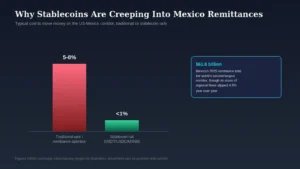
Traditional remittance fees on the US-Mexico corridor typically run 5-8%, while stablecoin rails operate under 1%, a gap driving adoption.
Mexico Payments News: The Murat Initiative Stablecoin Bill
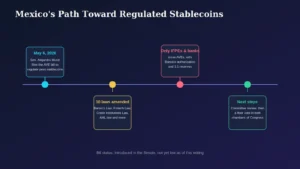
The single biggest Mexico payments news story of 2026 so far is legislative, not corporate. On May 6, 2026, Senator Alejandro Murat Hinojosa, a former governor of Oaxaca now sitting for the Morena parliamentary group, introduced a bill in the Mexican Senate to formally regulate what the text calls Activos Virtuales Estables Referenciados en Moneda Nacional, AVEs for short: peso-referenced stablecoins.
It’s not a light-touch proposal. The bill amends or adds provisions across ten separate pieces of Mexican financial law at once, including the Banxico Law, the 2018 Fintech Law, the Credit Institutions Law, the CNBV Law, CONDUSEF consumer protection rules, the Securities Market Law, and the federal anti-money laundering statute. Murat has publicly said the initiative draws heavily on the structure of the United States’ GENIUS Act, the federal stablecoin framework passed in 2025.
What the Murat Initiative Would Actually Require
Under the proposal, only Electronic Payment Fund Institutions, IFPEs in Mexican regulatory shorthand, and licensed banking institutions with specific Banxico authorization would be allowed to issue or manage AVEs. Every AVE would need to maintain 1:1 convertibility into pesos, with Banxico gaining a new statutory role overseeing conversion and settlement. The bill explicitly states that AVEs are not legal tender, are not part of the monetary base, and don’t count as bank deposits, they’d sit in their own regulatory lane as private payment instruments under a dedicated prudential regime.
Banxico’s own December 2025 Financial Stability Report had already flagged stablecoins’ growing role in remittances, so the bill isn’t coming out of nowhere. It reads as the central bank and legislature trying to get ahead of adoption that’s already happening organically, rather than reacting to a crisis.
The Murat Initiative would rewrite ten Mexican financial laws to bring peso-pegged stablecoins under formal Banxico oversight.
Where the Bill Stands Right Now
As of this writing, the Murat Initiative is a Senate bill, not law. It still needs committee review and a floor vote in both chambers of Mexico’s Congress before anything changes in practice. Fintech México’s director general has publicly called it a step toward democratizing access to these assets, while analysts covering the bill note the political alignment between the Senate Foreign Relations Committee, the Treasury Committee, and Banxico’s own stated priorities suggests it has a real chance of advancing during the 2026 legislative session, possibly with amendments along the way.
Worth noting: this isn’t the only digital-money bill in play. Senator Indira Kempis has separately proposed legislation to establish a Mexican central bank digital currency as legal tender, a different and more state-controlled approach than Murat’s private-issuer stablecoin model. The two proposals represent genuinely different visions for how Mexico digitizes its currency, and it’s not yet clear which one, if either, ends up moving furthest.
What This Means for the US-Mexico Remittance Corridor
Mexico received an estimated $61.8 billion in remittances in 2025, still the world’s second-largest single corridor by volume, even though its share of total Latin American remittance flows slipped about 4.5% year over year as money increasingly moves toward Central American corridors like Guatemala and Honduras instead.
A new 1% U.S. federal tax on remittances, layered on top of already existing wire and cash-pickup fees that traditionally run 5% to 8% of the transfer amount, is nudging senders toward cheaper digital alternatives, and stablecoin rails are one of the direct beneficiaries. That said, it’s worth being straight about the limits here: stablecoin transfers are fast and cheap on the blockchain leg, but the total cost to a sender still depends heavily on on-ramp and off-ramp fees, local liquidity, and whether the recipient has an easy way to convert stablecoins back into spendable pesos. A Forbes analysis in June 2026 made this point directly, stablecoin cross-border payments are faster, but they aren’t reliably cheaper yet, because the deep institutional liquidity needed to consistently undercut traditional FX brokers isn’t fully there.
Frequently Asked Questions
What is the biggest Mexico payments news story right now?
The Murat Initiative, a Senate bill introduced May 6, 2026, that would create Mexico’s first formal legal framework for peso-pegged stablecoins, is the most significant Mexico payments development of 2026. It would put Banxico in charge of authorizing issuers and overseeing 1:1 peso convertibility.
What is MXNB?
MXNB is a Mexican peso-backed stablecoin launched by crypto exchange Bitso through its subsidiary Juno. It’s designed to let businesses and remittance senders move pesos on-chain with near-instant settlement, and Bitso says it already handles a meaningful share of US-to-Mexico remittance volume.
Is SPEI the same as a stablecoin?
No. SPEI is Mexico’s traditional real-time interbank payment system, run by the central bank since 2004. Stablecoins are a separate, blockchain-based form of digital dollars or pesos. Some newer products, like Bitget Wallet’s integration with alfred, let users fund stablecoin wallets directly through a SPEI bank transfer, effectively bridging the two systems.
How much does it cost to send money to Mexico?
Traditional wire transfers and remittance operators typically charge 5% to 8% of the transfer amount. Stablecoin-based transfers can bring the blockchain-level cost under 1%, though total cost to the end user still depends on on-ramp and off-ramp conversion fees, which can offset some of the savings.
Is the Murat Initiative law yet?
No. As of mid-2026, it remains a bill introduced in the Mexican Senate. It requires committee review and approval by both chambers of Congress before it takes effect, and Banxico would then have 180 days after enactment to issue implementing rules.
The Takeaway
If you’re only tracking cash-versus-card statistics, you’re following last year’s Mexico payments story. The one that actually matters right now is regulatory: whether the Murat Initiative clears Congress and gives Banxico formal authority over peso stablecoins, while companies like Bitso, Tether, and Bitget Wallet keep building the on-ramps and treasury tools that assume it eventually will. None of this replaces SPEI or makes cash disappear overnight, Mexico’s underbanked population and cash-dependent retail habits aren’t changing that fast. But for cross-border payments specifically, especially remittances and corporate treasury transfers, the direction is clear enough that it’s worth watching closely through the rest of 2026.
Related reading: for more on how AI and regulatory scrutiny are intersecting with crypto-linked legal cases, see our coverage of the Sullivan & Cromwell AI hallucination error tied to the Chen Zhi crypto fraud case, on Blockyr.
External reference: Sistema de Pagos Electrónicos Interbancarios (SPEI) — Wikipedia for background on Mexico’s central bank payment system.