

Search Epstein Bitcoin right now and you’ll get two very different internets. One side is full of screenshots claiming Epstein secretly created Bitcoin. The other side, the one built on actual Department of Justice document releases, tells a story that’s less cinematic but honestly more disturbing in its own quiet way: a convicted sex offender who spent years, after his conviction, cultivating access to the people building crypto’s foundational infrastructure.
This piece sticks strictly to what’s documented. No speculation dressed up as fact, no viral screenshots taken at face value. Just what the DOJ files actually contain, what they don’t, and why crypto’s early funding history is worth understanding regardless of how uncomfortable it is.
What Is the Epstein Bitcoin Connection, Really?
Bitcoin shows up more than 1,500 times across the released files, according to reporting that’s combed through the document trove. That number alone fuels a lot of the wilder theories floating around. But volume of mentions isn’t the same as involvement, and separating the two is the entire point of this article.
The real story is about proximity and money, not creation or control. Epstein invested in two crypto companies, donated to an academic program that helped fund Bitcoin’s core developers, and reached out directly to several early Bitcoin figures. All of that happened after his 2008 conviction for procuring a minor for prostitution, which is a detail worth sitting with rather than skipping past.
Verified Facts: What the DOJ Documents Actually Show
Three specific financial threads run through the confirmed record. Each one is documented through emails, investment records, or on-the-record statements from the people involved, not anonymous leaks or forum speculation.
The Coinbase Investment
Through a US Virgin Islands entity, Epstein put roughly $3 million into Coinbase’s 2014 Series C funding round, when the exchange was valued at around $400 million pre-money. Crypto entrepreneur Brock Pierce is reported to have introduced the deal, and Coinbase co-founder Fred Ehrsam reportedly discussed a potential meeting with Epstein around that time. The stake represented less than 1% of Coinbase’s equity. Epstein later sold roughly half his position to Pierce’s Blockchain Capital in 2018 for about $15 million, with reports estimating his remaining shares could have been worth around $30 million by Coinbase’s 2021 public listing.
The Blockstream Investment
Epstein also put roughly $500,000 into Blockstream, a company that built core Bitcoin infrastructure, through a fund connected to former MIT Media Lab director Joi Ito. He corresponded directly with Blockstream co-founders Austin Hill and Adam Back around 2014. Back has since said publicly that Blockstream itself has no financial connection to Epstein or his estate, framing the investment as something that flowed through Ito’s fund rather than a direct relationship with the company.
The MIT Digital Currency Initiative Donations
This is the connection that draws the most scrutiny, because of what that money reportedly enabled. Epstein donated somewhere around $850,000 to MIT between 2002 and 2017, with a chunk of that, roughly $525,000, directed specifically to the Digital Currency Initiative. Ito had described that program as Bitcoin research’s central home and funding source. Reporting indicates the timing mattered: this funding arrived during a period when Bitcoin Core developers had lost stable financial backing after an earlier funding source collapsed, and the DCI’s support reportedly helped keep a small number of maintainers paid during that fragile stretch.
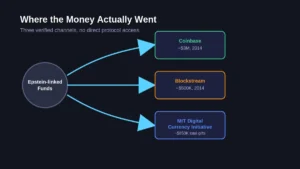
Three documented channels moved Epstein-linked money toward crypto’s early infrastructure, none of which handed him control over Bitcoin itself.
Did Epstein Try to Influence Bitcoin’s Development?
The documents suggest he wanted to. Emails show Epstein reaching out to Gavin Andresen, who took over as lead maintainer of Bitcoin’s source code after Satoshi Nakamoto stepped back, as early as 2011, arranging meetings through mutual connections including investor Jason Calacanis. He also corresponded with Jeremy Rubin, a Bitcoin Core contributor and MIT Digital Currency Initiative co-founder, discussing potential ways to fund Rubin’s research or back specific projects.
What’s notable is Epstein’s own apparent caution in some of these exchanges. In one email discussing a Bitcoin mining deal Rubin pitched him, Epstein reportedly pushed back, describing a proposal to “pump the currency” as something that carried real risk given his public profile. Whether that reflects genuine ethical hesitation or just reputational calculation is something the documents can’t answer, and speculating past what’s written would be exactly the kind of unsupported leap this article is trying to avoid.
The Satoshi Nakamoto Myth: Debunked
This is the claim that refuses to die despite having zero documentary support: the idea that Epstein was secretly Satoshi Nakamoto, Bitcoin’s pseudonymous creator. It isn’t true, and it’s worth being direct about that rather than hedging.
No code commit, wallet address, technical writing sample, or piece of correspondence in the millions of released pages connects Epstein to Bitcoin’s 2008 whitepaper or its early development. A widely circulated email supposedly proving the Satoshi link has been identified as fabricated and does not appear in the official DOJ release. Nakamoto’s actual identity remains unconfirmed to this day, and nothing in this document trove changes that.

Confusing financial proximity with technical control is where most of the viral misinformation around this topic goes wrong.
Key Figures Named in the Epstein Bitcoin Files
A handful of names recur throughout the correspondence, and it’s worth being precise about what each connection actually represents rather than treating every mention as equally significant.
Adam Back and Austin Hill, Blockstream’s co-founders, exchanged emails with Epstein around the company’s 2014 funding round. Back has publicly distanced the company from any current financial relationship with Epstein’s estate.
Joi Ito, former MIT Media Lab director, connected Epstein to both the Blockstream investment and the Digital Currency Initiative donations. Ito resigned from multiple institutional positions in 2019 once his ties to Epstein became public.
Gavin Andresen and Jeremy Rubin, both prominent Bitcoin Core-affiliated developers, had direct email exchanges with Epstein, though the substance stayed largely at the level of introductions and funding discussions rather than technical collaboration.
Brock Pierce, Tether co-founder, brokered the Coinbase introduction and maintained ongoing contact with Epstein, some of which involved troubling personal exchanges that go well beyond crypto business and reflect Epstein’s broader pattern of predatory behavior.
Michael Saylor, later the face of Strategy’s Bitcoin treasury strategy, appears only peripherally, through an unflattering description shared with Epstein by a publicist years before Saylor’s crypto pivot. There’s no evidence of any direct business relationship between the two.
Why This Story Matters for Crypto’s Credibility
Crypto has spent over a decade trying to shed a reputation for shady money and bad actors. Finding a convicted sex offender’s name woven into the funding history of Coinbase, Blockstream, and MIT’s Bitcoin research program doesn’t help that image, even if the dollar amounts were relatively small in the context of those companies’ overall fundraising.
Bitcoin developer Luke Dashjr has publicly called for accountability from figures connected to these revelations, while others in the industry have downplayed the significance, framing it as old history that doesn’t affect how the technology functions today. Both reactions miss something worth holding onto simultaneously: Bitcoin’s decentralized structure genuinely did prevent any single funder, including Epstein, from controlling its direction, and the fact that his money moved through respected institutions for years without public scrutiny says something uncomfortable about how due diligence worked in crypto’s early funding rounds.
What This Doesn’t Mean
It’s worth being just as clear about the limits of this story as the facts within it. There’s no evidence Epstein held Bitcoin directly, no known wallet address tied to him in the DOJ files, and no indication he had any technical role in the protocol’s development. Bitcoin’s open-source structure, maintained by thousands of independent contributors across more than a decade, was never something one donor or investor could quietly redirect. Proximity to funding is not the same thing as ownership, and conflating the two is how misinformation spreads fastest on this particular topic.
Timeline: How the Epstein Bitcoin Story Came to Light
Context matters here because this isn’t a story that broke all at once. Epstein died in federal custody in 2019, years before any of this financial detail became public. The crypto-related correspondence only surfaced later, in batches, as the Department of Justice released portions of its Epstein files throughout early 2026. The Coinbase and Blockstream investment details, along with the MIT donation records, emerged in one of the earlier document tranches, prompting immediate statements from Adam Back and other named individuals seeking to clarify or distance themselves from the coverage.
A subsequent release focused more heavily on Epstein’s direct correspondence with developers like Gavin Andresen and Jeremy Rubin, which is where the picture of Epstein actively trying to build relationships with Bitcoin’s technical community became clearer. Each new batch has tended to add texture rather than overturn earlier findings, reinforcing the same basic shape: financial proximity and networking, not technical control.
Was Jeffrey Epstein connected to Bitcoin?
Yes, financially. DOJ documents confirm Epstein invested roughly $3 million in Coinbase and about $500,000 in Blockstream, and donated close to $850,000 to MIT, some of which supported Bitcoin Core developer funding. He held no technical role in Bitcoin’s protocol.
Was Epstein Satoshi Nakamoto?
No. No document, code sample, wallet, or verified email in the DOJ file release connects Epstein to Bitcoin’s creation or to Satoshi Nakamoto’s identity. A viral email claiming otherwise has been identified as fabricated.
Did Epstein’s money fund Bitcoin’s code directly?
Not directly. His donations went to MIT as an institution, specifically its Digital Currency Initiative, which in turn helped pay some Bitcoin Core developers during a funding gap. The money supported academic salaries, not code commits or protocol governance rights.
Does Epstein own Bitcoin or crypto wallets?
No known Bitcoin wallet address or confirmed BTC holdings are linked to Epstein in the released DOJ files. The documented financial connections are limited to equity investments in Coinbase and Blockstream, plus academic donations to MIT.
Which crypto companies or people are named in the Epstein files?
Coinbase, Blockstream, and MIT’s Digital Currency Initiative are the three institutions with confirmed financial ties. Individuals named in correspondence include Adam Back, Austin Hill, Joi Ito, Gavin Andresen, Jeremy Rubin, and Brock Pierce, among others.
The Bottom Line on Epstein and Bitcoin
The Epstein Bitcoin connection is real, but it’s a story about financial proximity and institutional oversight failures, not secret control over the world’s largest cryptocurrency. Bitcoin’s design made it structurally resistant to exactly the kind of influence Epstein appears to have wanted. What the documents do reveal is a pattern: a convicted offender kept finding doors that stayed open long after they should have closed. For more coverage on how crypto markets, companies, and key figures intersect, our crypto news coverage on the Blockyr homepage is a good place to keep following the story as new documents and reporting emerge.
For background on Bitcoin’s actual origins and technical design, Wikipedia’s Bitcoin entry is a solid, neutral starting point.