



If you are searching bitcoin depot stock right now, you are probably not looking for a buy rating. You are looking for an explanation, because the stock you may have been watching, or holding, just fell off a cliff. Bitcoin Depot, the company that built the largest network of bitcoin ATMs in North America, filed for Chapter 11 bankruptcy on May 18, 2026. Every one of its roughly 9,000 kiosks went dark the same day.
This is not a rumor or a speculative downgrade. It is a court filing in the Southern District of Texas, and it changes what Bitcoin Depot stock actually represents to anyone still holding shares. This article walks through exactly what happened, why it happened, where BTM stands today, and what the whole episode says about the bitcoin ATM business model more broadly.

What Is Bitcoin Depot Stock (BTM)
Bitcoin Depot Inc. traded on Nasdaq under the ticker BTM. Founded in 2016 and headquartered in Atlanta, the company built its business around physical kiosks that let people convert cash into bitcoin at convenience stores, gas stations, pharmacies, and grocery chains across 47 states and parts of Canada, Australia, and Hong Kong. It went public through a SPAC merger in 2023, and at its peak operated more than 9,000 machines, by far the largest footprint of any bitcoin ATM operator in North America.
The pitch to investors was simple. Bitcoin ATMs charge steep transaction fees, often somewhere between 10 and 20 percent per trade, a margin that looked attractive in a growth market with limited competition. That same fee structure and the largely unregulated nature of the machines eventually became the company’s biggest liability.
Why Bitcoin Depot Stock Collapsed
The short version. Revenue fell off a cliff, regulators closed in from multiple directions at once, and the company ran out of room to absorb the damage.
The financial picture before the filing
Bitcoin Depot reported a 49.2 percent year over year revenue decline for the first quarter of 2026, posting a 9.5 million dollar net loss compared with 12.2 million dollars in net income the year before. The company had already issued a going concern warning on May 12, just six days before the bankruptcy filing landed. Total debt sat around 27 million dollars against a business whose core revenue engine had essentially stopped growing.
Regulatory pressure that kept piling up
States started clamping down hard on bitcoin ATMs, largely in response to a well documented scam pattern where fraudsters direct victims, often elderly, to deposit cash into a BTM after posing as government officials or tech support agents. Indiana banned bitcoin ATMs outright, and Tennessee followed with its own ban effective July 1, 2026. California imposed a 1,000 dollar daily withdrawal limit that Bitcoin Depot specifically called out as its toughest regulatory obstacle. On top of the state level bans, the attorneys general of Massachusetts and Iowa sued the company in February 2025 alleging it played a role in a scam that cost victims roughly 20 million dollars.
Leadership turnover and a security breach
Connecticut suspended the company’s money transmission license in early 2026, which triggered a leadership shake up. CEO Scott Buchanan departed in March, replaced by Alex Holmes. A month later, hackers breached Bitcoin Depot’s IT systems and stole 3.7 million dollars from company crypto wallets, an ugly headline landing right in the middle of an already fragile quarter.
Bitcoin Depot Stock Price Timeline
- February 2022, Bitcoin Depot went public via SPAC merger at an original listed price around 70 dollars per share.
- Through 2025, shares gradually eroded as growth slowed and margins came under pressure from mounting compliance costs.
- October 2025, the company raised 15 million dollars through a registered direct offering priced at 3.50 dollars per share, an early signal of tightening liquidity.
- May 12, 2026, Bitcoin Depot issued a formal going concern warning.
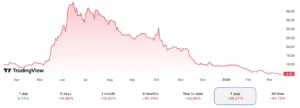
- May 18, 2026, the company filed for Chapter 11 and the stock cratered roughly 80 percent in a single move, sliding from around 3 dollars toward well under a dollar.
- In the weeks after the filing, BTM traded as a speculative penny stock under a dollar, eventually carrying a Q suffix common for companies in bankruptcy proceedings, with a market cap that shrank into the low single digit millions.
-
Bitcoin Depot Stock
That drop from a 70 dollar SPAC debut to a stock trading for pennies is one of the steeper collapses the crypto adjacent equity space has seen, and it happened almost entirely inside a single trading session once the bankruptcy news hit the wire.
What Chapter 11 Means for Bitcoin Depot Shareholders
Chapter 11 is a reorganization process, not automatic liquidation, so there is technically a path where a company emerges in some restructured form. Bitcoin Depot’s own filings, though, describe this specifically as an orderly wind down and asset sale rather than an attempt to keep the current business model alive. The company stated outright that the existing model is not sustainable given the regulatory environment it now operates in.
Bitcoin Depot’s own securities filings warn that holders of Class A common stock could see a significant or complete loss of their investment depending on how the case plays out. In Chapter 11, secured creditors and lenders get paid from asset sale proceeds before equity holders see a cent, and equity is typically the last claim in line. All employees, including executives, received WARN Act termination notices, with executive employment expected to end around July 17, 2026, which tells you how final this wind down is intended to be.
Is Bitcoin Depot stock still tradable
Technically some trading activity can continue during bankruptcy proceedings, but it is explicitly speculative and disconnected from the underlying operating business, since that business has been taken offline. Anyone trading BTM shares at this stage is trading on the outcome of a bankruptcy sale process, not on ATM transaction volume, because there is no more ATM transaction volume to speak of.
What This Means for the Broader Bitcoin ATM Industry
Bitcoin Depot was not a fringe player. It was the largest bitcoin ATM network in North America, and its collapse is being read across the industry as a preview rather than an isolated failure. Restructuring advisors have pointed out that the traditional bitcoin ATM business model depended on high transaction spreads and comparatively light regulatory scrutiny, and both of those advantages have been eroding fast. Competing operators like CoinFlip and Coinme are now operating in a landscape where several states have banned the machines outright and others are actively tightening withdrawal limits and fraud liability rules.
There is a real tension worth naming here. Bitcoin ATMs served a genuine purpose for unbanked and underbanked people who wanted a cash path into bitcoin without a bank account or exchange verification. They also became one of the most reliable tools scammers use to extract cash from vulnerable victims, particularly seniors. Regulators cracking down on the machines are addressing a real fraud problem, even if the side effect is cutting off a legitimate access point for some users.
Lessons for Investors Watching Bitcoin Depot Stock
- A steep, sudden stock collapse after a going concern warning is rarely a buying opportunity. It is usually the market pricing in exactly what the company just confirmed.
- Regulatory risk in crypto adjacent businesses can move faster than earnings guidance ever suggests. A handful of state level bans turned a growth story into a liquidation filing in a matter of months.
- Revenue concentrated in a single, thinly regulated niche is fragile by nature. When that niche gets regulated, there may be no fallback business to lean on.
- If you are evaluating other low priced, speculative names in this space, treat every one of them with the same scrutiny, our breakdown of stocks under 1 dollar that could move sharply covers exactly this kind of volatility and why position sizing matters more than conviction in these names.
Bitcoin Depot Stock FAQs
Why did Bitcoin Depot stock crash?
Bitcoin Depot stock crashed after the company filed for Chapter 11 bankruptcy on May 18, 2026, following a 49.2 percent revenue decline, a going concern warning, and mounting state level regulatory bans and lawsuits tied to bitcoin ATM fraud.
Is Bitcoin Depot stock a buy right now?
No responsible answer treats it as a standard buy. The company has stated its current business model is unsustainable, taken its entire ATM network offline, and warned shareholders of a possible total loss of investment during the bankruptcy process.
Did Bitcoin Depot go out of business?
Bitcoin Depot filed for Chapter 11 to wind down operations and sell its assets rather than continue operating. Its roughly 9,000 ATM kiosks were taken offline on the filing date, effectively halting the core business even though the legal entity still exists during proceedings.
What happens to BTM shares in bankruptcy?
Secured creditors and lenders are paid first from any asset sale proceeds. Common stockholders sit last in line and, based on the company’s own risk disclosures, could see a significant or total loss depending on how much the asset sale ultimately recovers.
Are bitcoin ATMs safe to use after Bitcoin Depot’s collapse?
Bitcoin Depot’s machines are offline entirely, so that specific network is not usable. More broadly, bitcoin ATMs across the industry carry high fees and have been repeatedly linked to scam schemes, so treat any bitcoin ATM transaction, from any operator, with the same caution you would apply before wiring money to someone you have never met.
Final Take on Bitcoin Depot Stock
Bitcoin Depot’s fall is a case study in how quickly a niche crypto business can unravel once regulators decide the risk to consumers outweighs the convenience the business provides. The company did not fail because bitcoin failed. It failed because its entire model leaned on thin oversight and high fees, and once states started closing that gap, there was no revenue left to absorb the hit. If you are holding BTM shares, the honest read is that you are holding a bankruptcy claim now, not a growth stock, and the outcome depends entirely on what the asset sale recovers, not on where bitcoin’s price goes next.
For more on how bankruptcy proceedings like this actually work, see the Wikipedia page on Chapter 11 bankruptcy.