

Type nft hicetnunc into Google and you’ll notice something odd right away: half the results talk about it in past tense, and the other half link to a site called Teia that isn’t actually called hicetnunc anymore. That confusion is completely fair. Hicetnunc, often shortened to HEN or written as h=n, was one of the most important NFT marketplaces to ever exist, and its story doesn’t have a clean, tidy ending. It has a weirder one, and honestly a more interesting one.
I’ve spent time digging through what actually happened here, not just the headline version everyone repeats, and there’s a lot more nuance worth knowing if you’re a collector trying to track down old pieces, an artist curious about minting on Tezos, or just someone who keeps seeing the name pop up in crypto art conversations.
What Was Hicetnunc (HEN)?
Hicetnunc launched in March 2021, built by Brazilian developer Rafael Lima as an open source experiment on the Tezos blockchain. The name is Latin for “here and now,” and the platform lived up to it in spirit: no gatekeepers, no approval process, anyone could mint art the moment they connected a wallet. Artists uploaded their work, and it became what the platform called an OBJKT, essentially Tezos’s version of an NFT built on the FA2 token standard.
What made hicetnunc stand out wasn’t just the low barrier to entry, it was the cost. Minting on Ethereum-based marketplaces during 2021 could run you anywhere from $50 to several hundred dollars in gas fees depending on network congestion. On hicetnunc, minting cost a fraction of a dollar. That single difference opened the door for artists from the Global South, queer creators, and experimental digital artists who’d been priced out of the Ethereum NFT boom entirely.
Why NFT Hicetnunc Became So Popular So Fast
Within months, hicetnunc had over 100,000 minted objects and had become the top dapp on the entire Tezos chain, pulling in more than 16,000 unique active wallets and over a million dollars in weekly trading volume at its peak. It also ran on Tezos’s proof-of-stake consensus, which meant a fraction of the energy footprint compared to Ethereum’s older proof-of-work model, a detail that mattered a lot to artists who’d grown uncomfortable with the environmental narrative around NFTs in 2021.
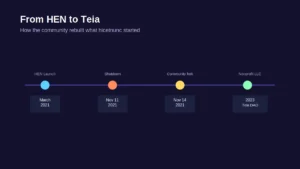
From a sudden November 2021 shutdown to a community-run nonprofit DAO by 2023, hicetnunc’s story kept evolving.
Why Did Hicetnunc Shut Down?
This is the part everyone remembers, even if the details get fuzzy. On November 11, 2021, hicetnunc.xyz simply went dark. No warning post, no announcement thread, just a broken URL and a Twitter bio that read “discontinued.” Founder Rafael Lima never gave a full public explanation, though community speculation pointed to a mix of burnout, internal disagreements among contributors, and friction around a competing marketplace called Objkt that had launched minting features around the same time.
The panic that followed says a lot about how misunderstood NFTs still were at that point. A huge portion of the community assumed their art was simply gone. It wasn’t. This is worth explaining clearly because it’s still one of the most searched confusions around the platform: the NFTs themselves live on the Tezos blockchain and the associated files sit on IPFS, a decentralized storage network. Hicetnunc’s website was only ever a front-end, a window into that data. When the window closed, everything behind it stayed exactly where it was.
How the Community Rebuilt What Hicetnunc Started
Within days, Lima handed control of a mirror domain to a Tezos infrastructure group, and the community began organizing what would eventually become Teia, officially registered as a nonprofit DAO LLC in 2023. Teia isn’t a separate blockchain project pretending to be hicetnunc’s successor, it’s a direct code fork of the original open source platform, run by roughly two dozen volunteer core team members and governed by token-weighted community votes. The marketplace fee structure stayed nearly identical too, sitting at 2.5%, which remains dramatically lower than the 15% or higher fees common on many larger NFT platforms.
Where Can You Find Hicetnunc NFTs Today?
If you’re hunting for old HEN-era pieces or want to keep collecting in that same spirit, you’ve got a few legitimate paths. Teia.art is the most direct continuation, run by former hicetnunc contributors and preserving the original’s community-first values. Objkt.com has grown into the largest aggregator marketplace on Tezos, pulling in listings from Teia and other platforms into one searchable hub, which makes it the easiest starting point if you’re not sure exactly where a specific piece lives. There’s also akaSwap, popular within Asian NFT communities on Tezos, and newer generative art platforms like fxhash and Bootloader that have grown out of the same ecosystem.
A word of caution here: because the original hicetnunc.xyz domain went dark, a handful of copycat and phishing sites have popped up over the years using similar branding. Always double check you’re interacting with a verified contract address before connecting a wallet or approving a transaction, and stick to well-known platforms rather than random links shared in Discord or Twitter DMs.
Minting on Teia still follows the low-fee, no-gatekeeper philosophy hicetnunc pioneered back in 2021.
How to Mint NFTs the Hicetnunc Way on Tezos Today
The workflow hasn’t changed much from HEN’s original design, which is honestly part of the appeal. You’ll need a Tezos-compatible wallet like Temple or Kukai, some XTZ to cover minting costs, which typically runs under a dollar, and a file to upload. Head to Teia.art or Objkt, connect your wallet, fill in a title and description, set your royalty percentage, and confirm the mint transaction. No application, no waitlist, no curator approval. That permissionless structure was hicetnunc’s biggest philosophical contribution to the NFT space, and it’s one that Teia has deliberately preserved rather than tightened up.
If you’re new to Tezos NFTs entirely, a few of the so-called “fountains” still exist, small community-run faucets that hand out a bit of free XTZ specifically so new artists can activate a wallet and mint their first piece without needing to buy crypto first. It’s a small detail, but it captures the accessibility-first mindset that made hicetnunc different from its Ethereum-based competitors in 2021.
Is Hicetnunc Still Relevant in 2026?
The brand name itself is effectively retired, but its DNA is everywhere in the current Tezos NFT ecosystem. Teia continues operating as a nonprofit with an active governance structure, Objkt has become the default aggregator most collectors use daily, and the broader Tezos art scene, from generative art platforms to institutional partnerships with museums exploring blockchain-based curation, traces its roots directly back to what hicetnunc proved was possible: a genuinely open, low-cost, artist-first NFT marketplace that didn’t need gatekeepers to thrive.
Whether that counts as hicetnunc still being “alive” depends on how you define a platform. The original website is gone. The community, the contracts, the values, and a meaningful chunk of the original team are not.
Hicetnunc vs Ethereum NFT Marketplaces: What Was Actually Different
It’s easy to lump every NFT marketplace from 2021 into one category, but hicetnunc’s approach diverged from Ethereum-based platforms like OpenSea and SuperRare in ways that actually mattered to the people using them. OpenSea in 2021 charged gas fees that regularly spiked into the hundreds of dollars during network congestion, on top of a 2.5% platform fee. SuperRare and Foundation added curation gates, meaning an artist needed an invite or approval before they could mint anything at all. Hicetnunc rejected both of those friction points outright: minting cost cents, not dollars, and there was no waitlist standing between an artist and their first sale.
That combination shaped who actually showed up. Ethereum’s NFT scene in 2021 skewed toward established digital artists and speculative flippers chasing profile-picture projects. Hicetnunc’s low cost of entry pulled in a noticeably different crowd: generative coders, sound artists, animators, and creators from regions where a $200 minting fee simply wasn’t realistic. That’s not a minor cultural footnote, it’s arguably the platform’s most lasting contribution. A lot of the artists who got their start minting on hicetnunc in 2021 are still active in the Tezos ecosystem today, some now showing work through institutional partnerships between Tezos and museums exploring blockchain-based art curation.
The hDAO Token and What It Was Meant to Do
Hicetnunc also launched with its own governance token called hDAO, capped at a fixed supply of 651,000 tokens and distributed to early buyers and sellers as a usage incentive. The idea was that hDAO would eventually function as both a promotional tool, letting holders boost visibility for NFTs they liked, and a governance mechanism for platform decisions. In practice, the governance side of hDAO never fully materialized before the November 2021 shutdown, and the token’s role today is more of a historical artifact than an active utility, though it still trades and holds meaning for collectors who were part of the platform’s earliest days.
What is hicetnunc (HEN)?
Hicetnunc was an open source NFT marketplace launched in March 2021 on the Tezos blockchain, known for extremely low minting fees, no gatekeeping, and a strong community of independent digital artists. It shut down abruptly in November 2021.
Why did hicetnunc shut down?
Founder Rafael Lima took the site offline on November 11, 2021, without a full public explanation. Community speculation pointed to burnout and internal disagreements, though the underlying smart contracts and NFTs remained fully intact and accessible on the blockchain.
Are hicetnunc NFTs lost forever?
No. NFTs minted on hicetnunc still exist on the Tezos blockchain, with associated files stored on IPFS. The website going offline only removed the front-end interface, not the underlying ownership records or artwork data.
What replaced hicetnunc?
Teia.art is the direct community-led successor, built from a fork of hicetnunc’s original open source code and governed as a nonprofit DAO since 2023. Objkt.com has also become the leading aggregator marketplace for Tezos NFTs generally.
Is it still cheap to mint NFTs on Tezos today?
Yes. Minting on Tezos through platforms like Teia or Objkt typically costs less than one US dollar, a fraction of what minting costs on many Ethereum-based marketplaces, thanks to Tezos’s energy-efficient proof-of-stake design.
The Bottom Line on NFT Hicetnunc
Hicetnunc’s story is a genuinely useful case study in what decentralization actually protects and what it doesn’t. A website can vanish overnight and the art survives anyway, because ownership was never tied to a company’s servers in the first place. If you’re exploring the broader crypto and NFT landscape and want more context on how digital assets are valued and traded, our crypto market coverage on the Blockyr homepage is a good place to keep exploring as new articles go live.
For more background on the broader category these platforms belong to, Wikipedia’s non-fungible token entry is a solid, neutral starting point.