


A firm that bills roughly $2,000 an hour for bankruptcy work is not supposed to file a brief full of made-up case law. But that’s exactly what happened this year, and the story sits at an odd intersection: an elite Wall Street law firm, an AI tool that invented legal citations out of thin air, and a Cambodian crypto fraud case involving $15 billion in seized bitcoin. If you’ve searched “sullivan & cromwell ai error,” here’s the full picture, without the legal jargon.
Sullivan & Cromwell’s court filing contained AI-generated citations that simply didn’t exist.
What Happened With Sullivan & Cromwell’s AI Filing
On April 9, 2026, Sullivan & Cromwell filed an emergency motion in a Chapter 15 bankruptcy proceeding in the U.S. Bankruptcy Court for the Southern District of New York. The case involved Prince Global Holdings Limited, the corporate shell tied to Cambodian businessman Chen Zhi and his sprawling Prince Group conglomerate.
The motion looked routine. It wasn’t. Buried inside were citations to cases that don’t exist, quotes attributed to court opinions that never said those words, and at least one misquoted section of the U.S. Bankruptcy Code itself. These are what lawyers now call AI hallucinations, a polite way of saying the AI tool confidently made things up and nobody caught it before hitting file.
Nobody at Sullivan & Cromwell flagged the problem first. Opposing counsel did. Boies Schiller Flexner, representing another party in the case, went through the citations and found the fabrications.
The Apology Letter to Judge Glenn
On Saturday, April 18, Andrew Dietderich, co-head of Sullivan & Cromwell’s global restructuring group, wrote directly to U.S. Bankruptcy Chief Judge Martin Glenn. The letter did not try to spin the situation. Dietderich apologized on behalf of the entire team, said he’d personally called Boies Schiller Flexner to thank them and apologize, and attached a three-page, single-spaced list correcting every error the firm could find.
His explanation, in plain terms: the firm has AI usage policies specifically designed to prevent this kind of thing, and for this particular filing, those policies weren’t followed. That’s a notable admission from a firm this size. It wasn’t a rogue junior associate blindsided by unfamiliar technology. It was a lapse in a process the firm says it already had in place.
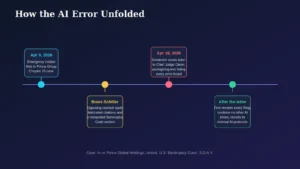
Timeline: how the Sullivan & Cromwell AI hallucination error surfaced, from the April 9 filing to the apology letter.
The Irony Nobody Missed: S&C Advises OpenAI on AI Safety
Here’s the detail that turned this from a routine correction letter into a story everyone in legal media wanted to cover. Sullivan & Cromwell publicly advises OpenAI on the safe and ethical deployment of artificial intelligence. That’s not a rumor, it’s on the firm’s own website as a client representation.
So the firm that counsels one of the world’s most prominent AI companies on responsible AI use ended up filing a federal court document full of AI-generated nonsense. Above the Law called it exactly what it looked like: a rich vein of dark comedy for anyone who follows Big Law. There’s a second layer of irony too. Boies Schiller Flexner, the firm that caught the errors, had itself been dinged for a similar AI mistake in a different case not long before. The hunter had recently been the hunted.
Why This Case Involves Crypto: The Chen Zhi Connection
This isn’t just a law firm story. The underlying case is one of the largest crypto fraud prosecutions in U.S. history, and that’s why it matters here.
Chen Zhi, also known as Vincent, is the founder and chairman of Prince Holding Group, a Cambodian conglomerate that presented itself publicly as a legitimate real estate, banking, and aviation business. Behind that front, according to a Brooklyn federal indictment unsealed in October 2025, Prince Group ran forced-labor scam compounds across Cambodia. Trafficked workers, held in prison-like conditions, were forced to run “pig butchering” scams: long-con crypto investment fraud that builds fake trust with victims before draining their money.
The scale is hard to overstate. U.S. authorities seized 127,271 bitcoin, worth roughly $15 billion at the time, in what the Department of Justice called the largest forfeiture action in its history. More than 250 victims in the Brooklyn area alone lost money to the network, and the total victim count worldwide runs into the thousands. Chen Zhi is charged with wire fraud conspiracy and money laundering conspiracy and remains at large, facing up to 40 years in prison if caught and convicted.
Sullivan & Cromwell’s role in this specific bankruptcy matter is representing foreign representatives tied to the wind-down of Prince Global Holdings Limited, the corporate entity now being unwound as part of the fallout. So the AI hallucination error didn’t happen in some minor contract dispute. It happened inside one of the most closely watched crypto fraud cases on record, in front of a chief bankruptcy judge, with opposing counsel actively combing through every citation.
AI Hallucinations in Legal Filings Are Becoming Common
Sullivan & Cromwell is far from alone, and that’s arguably the more important part of this story for anyone tracking how AI is reshaping professional work. A database compiled by Paris-based law lecturer Damian Charlotin now tracks over 1,300 documented cases worldwide where AI tools fabricated case citations, misquoted authorities, or invented legal sources entirely. U.S. judges have sanctioned attorneys in dozens of separate incidents for relying on AI-generated research without verifying it first.
Consulting firm Gartner recently advised general counsel at companies to start considering direct AI insurance coverage, specifically to protect against the financial and reputational fallout from AI-related mistakes like this one. That’s not a hypothetical risk category anymore. It’s showing up often enough that insurers and risk consultants are treating it as a distinct, insurable exposure.
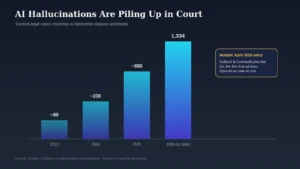
The number of tracked AI hallucination legal cases has grown sharply year over year, based on figures reported around the Charlotin database.
What Exactly Is an AI Hallucination in a Legal Context
Quick answer for anyone who wants the short version: an AI hallucination in law happens when a generative AI tool produces information that sounds authoritative and properly formatted but is factually wrong or entirely invented, such as a case that was never decided, a quote a judge never wrote, or a statute section that doesn’t say what the AI claims it says. Lawyers remain fully responsible for verifying everything before it’s filed, regardless of which tool produced the draft.
Why Lawyers Keep Getting Caught by This
It’s worth being honest about why this keeps happening, because the pattern is consistent across nearly every reported case. Large language models are built to produce fluent, confident-sounding text, not to know the difference between a real case and a plausible-sounding fake one. When you ask a general-purpose AI tool to find supporting case law, it will often generate something that has the right shape: a case name, a court, a year, a page citation, a quoted holding. Every element looks correct. None of it has to actually exist.
Add time pressure, and you get exactly what happened here. An emergency motion, by definition, gets filed fast. Fast filings get less review. Less review means a hallucinated citation slides past the associate who drafted it, past the partner who signed off, and straight into a federal docket, where opposing counsel, who has every incentive to check your work, eventually finds it.
Ethically, none of this shifts blame away from the lawyers. The American Bar Association and state bar associations have been consistent on this point: attorneys can use AI tools, but they carry the same duty of candor to the court whether a human or a machine drafted the first version. Courts have made the same point in sanctions rulings going back to the earliest hallucination cases in 2023.
What This Means If You’re Watching the Prince Group Case
For anyone following the crypto fraud angle specifically, the practical upshot is limited but real. Dietderich told the court the firm reviewed every filing made in the case after discovering the errors and confirmed there were no additional AI-generated inaccuracies elsewhere in the record. The underlying claims against Chen Zhi and Prince Group, the forced labor allegations, the fraud charges, the $15 billion bitcoin forfeiture, are unaffected by this filing error. Nothing about the AI mistake changes the substance of the case against Chen Zhi, who remains at large.
What it does change is scrutiny. Chief Judge Glenn now has a documented, in-writing admission that a major law firm’s internal AI safeguards failed on a filing in his courtroom. Expect closer review of future filings in this matter, and don’t be surprised if other parties in complex, high-dollar crypto litigation start double-checking citations from every firm involved, not just this one.
The Bigger Picture for Crypto-Related Litigation
Crypto cases are exactly the kind of complex, document-heavy, multi-jurisdiction litigation where AI drafting tools get used heavily, and where the underlying facts, blockchain forensics, cross-border asset tracing, sanctions overlaps, are genuinely hard to summarize by hand. That combination of complexity and time pressure is a recipe for exactly this kind of error showing up again. If you’re a crypto investor or a victim following a fraud case through the courts, it’s worth knowing that filing errors like this don’t usually derail a prosecution, but they can slow proceedings down and give defense teams an opening to challenge credibility on unrelated points.
Frequently Asked Questions
What did Sullivan & Cromwell actually get wrong?
The firm’s April 9, 2026 emergency motion in the Prince Global Holdings bankruptcy case contained AI-generated hallucinations, including fabricated case citations, misquoted legal authorities, and a misquoted section of the U.S. Bankruptcy Code. Opposing counsel, Boies Schiller Flexner, discovered the errors.
Was Sullivan & Cromwell sanctioned?
As of the apology letter, no sanctions had been announced. Dietderich’s letter to Chief Judge Martin Glenn was proactive, apologizing before any sanctions motion and detailing every error found. Courts have sanctioned attorneys in other AI hallucination cases, so the outcome here depends on the judge’s response.
How is this connected to a crypto fraud case?
Sullivan & Cromwell represents foreign representatives in the wind-down of Prince Global Holdings Limited, tied to Chen Zhi and Prince Group. Chen Zhi is charged with running forced-labor scam compounds in Cambodia that carried out crypto investment fraud, part of a case where the U.S. seized roughly $15 billion in bitcoin.
How common are AI hallucinations in legal filings?
A tracking database run by law lecturer Damian Charlotin has logged more than 1,300 cases worldwide involving AI-fabricated legal citations, and U.S. judges have sanctioned attorneys in dozens of separate incidents. The number has grown sharply since generative AI tools became common in legal research workflows.
Does this affect the case against Chen Zhi?
No. Sullivan & Cromwell said it reviewed all filings in the matter after finding the errors and confirmed no other AI-generated inaccuracies existed. The underlying fraud and forced-labor allegations against Chen Zhi, who remains at large, are unrelated to this filing mistake.
The Takeaway
Sullivan & Cromwell’s AI error isn’t really a story about one bad filing. It’s a preview of a problem that’s going to keep showing up as long as law firms lean on AI drafting tools without airtight verification steps, and as long as complex cases like the Prince Group crypto fraud prosecution keep generating enormous volumes of paperwork under tight deadlines. The firm’s own AI policies existed to prevent this exact outcome. They just weren’t followed on this one filing, and that’s the part every firm handling AI-assisted drafting should sit with.
Watching how Judge Glenn responds, and whether other firms in high-profile crypto litigation tighten their citation checks as a result, will tell you a lot about whether this becomes a turning point or just another entry in a fast-growing database.
Related reading: for more on the regulatory and geopolitical pressure building around institutional crypto activity, see our coverage of Elon Musk and the Iran-linked crypto market fallout on Blockyr.
External reference: Hallucination (artificial intelligence) — Wikipedia for a general explainer of how and why AI models generate false information.