



Jordan Belfort’s fortune traces back to Stratton Oakmont’s late-1990s peak.
Everyone remembers the yacht sinking in a storm off Sardinia. Or Leonardo DiCaprio crawling to his Lamborghini after a Quaalude binge. What people usually get wrong is the number attached to all of it. Search “Jordan Belfort net worth peak” and you’ll get five different figures from five different sites, none of them agreeing, most of them copying each other without checking the source.
So let’s settle it properly. At his absolute highest point, in the late 1990s, Jordan Belfort‘s net worth is widely estimated at around $400 million. That’s the figure most financial trackers land on, though it’s worth saying upfront: Belfort never filed a public net worth statement, Stratton Oakmont’s books were a mess by design, and any number this old is an estimate stitched together from court filings, journalist digging, and Belfort’s own (not always reliable) recollections. We’ll walk through where that $400 million figure comes from, why some sources say $90 million and others say $1 billion, what actually happened to the money, and what he’s sitting on now in 2026.
Jordan Belfort Net Worth Peak: The Short Answer
Jordan Belfort’s net worth peak is generally placed at roughly $400 million, reached around 1998 at the height of Stratton Oakmont’s run. Some estimates go as low as $90 million and others speculate over $1 billion in assets and stock issuance combined, but $400 million is the figure that shows up most consistently across financial biography sites and court-adjacent reporting.
How Belfort Actually Built That Fortune
Belfort didn’t inherit money or come up through a prestigious bank. He grew up in the Bronx, dropped out of dentistry school (literally, on day one, after a professor told the class there was no money left in dentistry), and bounced through a meat and seafood sales business before landing on Wall Street in the mid-1980s.
He founded Stratton Oakmont in 1989 at 27 years old. The firm wasn’t a normal brokerage. It specialized in what’s now called a “pump and dump” — Stratton’s brokers would aggressively push penny stocks the firm itself controlled large blocks of, inflate the price through high-pressure cold calls, then quietly sell their own shares once the price spiked, leaving retail investors holding stock that came crashing back down. It’s the exact playbook the film dramatizes, and it’s not exaggerated for effect. That’s genuinely how the firm operated.
At its peak, Stratton Oakmont employed over 1,000 brokers and had underwritten more than $1 billion worth of stock offerings. Belfort himself has said he made roughly $49 million in a single year in his mid-20s, and in interviews he’s broken that down to something like $30,000 an hour when the firm was running hot. Numbers like that are hard to independently verify decades later, but they line up with the lifestyle that followed: twelve real estate properties, nine cars including Ferraris and Lamborghinis, and a 167-foot yacht that had previously belonged to designer Coco Chanel, which he renamed Nadine after his second wife.
Where the $400 Million Figure Comes From
Most financial biography outlets trace the $400 million estimate to reporting done around Belfort’s fraud case in the late 1990s, when investigators were trying to reconstruct exactly how much money had moved through Stratton Oakmont and where it ended up. It’s an estimate of total wealth and controlled assets at the absolute top of the run, not a single audited bank statement.
You’ll also see other figures floating around:
- $90 million, a lower figure cited in a 2014 Independent profile, likely reflecting a narrower definition of personal (rather than firm-linked) wealth
- Over $1 billion, a figure that shows up when people conflate Belfort’s personal net worth with the total value of stock Stratton Oakmont issued and manipulated, which isn’t the same thing as money that ended up in Belfort’s pocket
Here’s the honest take: nobody outside Belfort’s accountants at the time knew the real number, and even they probably didn’t have a clean picture given how the firm cooked its books. $400 million is the most defensible middle estimate, and it’s the one we’ll use as the reference point for this article, but treat every net worth figure tied to Belfort’s peak years as an estimate, not a fact.
Quick answer for search
Jordan Belfort’s peak net worth is estimated at approximately $400 million, reached around 1998 during the height of Stratton Oakmont’s operations, based on reconstructed financial records and biographical reporting rather than a single audited disclosure.
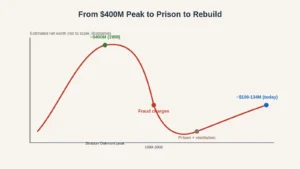
Estimated trajectory of Belfort’s net worth: peak, collapse, and rebuild (illustrative, not to scale).
The Collapse: How Fast It All Went
This is the part the movie compresses into a montage, but the real timeline stretched years. The SEC and FINRA’s predecessor (the NASD) had been circling Stratton Oakmont since the early 1990s. The firm was formally shut down in December 1996. Belfort himself wasn’t charged until 1999, when he pleaded guilty to securities fraud and money laundering.
The financial hit was brutal on paper: he was ordered to pay back an estimated $110 million in restitution to defrauded investors. He served 22 months of a four-year sentence, largely reduced because he cooperated extensively with federal prosecutors, wearing a wire to help build cases against former colleagues.
The restitution story is where a lot of the current confusion about his net worth comes from. For years, reporting noted he’d paid back only around $10 million of that $110 million obligation, which meant the debt was technically still hanging over every dollar he earned afterward. Whether a net worth estimate for Belfort should subtract that outstanding restitution is a genuine methodological question, and it’s a big part of why different sites land on wildly different current net worth figures for him.
What Jordan Belfort Is Worth Today
Fast forward to 2026, and most estimates put Belfort’s current net worth somewhere between $100 million and $134 million. That’s a real recovery from a man who, by his own account, hit rock bottom financially and personally in the early 2000s, but it’s still well under that $400 million peak, and it doesn’t fully account for what he still owes.
His current income breaks down into a few clear buckets:
- Speaking engagements: reportedly $30,000 to $75,000 per booking, with sales seminars through his company Global Motivation Inc. going even higher
- Book sales: The Wolf of Wall Street and its sequel Catching the Wolf of Wall Street have been published in roughly 40 countries, plus his 2017 follow-up Way of the Wolf
- Consulting and coaching: Belfort now sells his “Straight Line System” sales methodology to entrepreneurs, including, notably, founders in the crypto space
- Film and media rights: he was paid for the rights that became Scorsese’s 2013 film, which grossed north of $390 million at the box office and turned his story into a cultural reference point that keeps generating speaking demand years later
If there’s one thing worth being blunt about, it’s this: Belfort’s post-prison wealth is legitimate business income from speaking, writing, and coaching, but he’s built an entire second career monetizing the story of how he defrauded people the first time around. That’s not a moral judgment, it’s just a fact worth sitting with when you’re reading his net worth numbers.
Jordan Belfort and Crypto: Why This Matters Beyond Nostalgia
Here’s the angle most net worth explainers skip entirely, and it’s genuinely relevant if you’re reading this on a crypto site rather than a celebrity gossip page. Belfort has had a very public, very inconsistent relationship with cryptocurrency, and it says something about how he sees markets in general.
Back in 2018, he called the entire crypto sector a scam on CNBC, told investors there was “no good reason” for Bitcoin to exist beyond speculation, and predicted it would collapse. By 2023, he’d walked that back substantially, telling Benzinga he’d been “wrong about Bitcoin and Ethereum,” while still standing by his skepticism of roughly 99% of the rest of the market. He’s since said he only holds BTC and ETH personally.
That shift cost him directly, not just in credibility. According to reporting, Belfort had roughly $300,000 in a token called Ohm stolen out of his own crypto wallet, which is a fairly ironic footnote for a man once convicted of stealing other people’s money. He’s also kept up a steady drumbeat of public scam warnings, including a blunt “beware of crypto scams” post to his own followers in March 2024 — the same kind of caution worth applying whenever you’re weighing whether Bitcoin is actually dead against the noise of any given market cycle.
The pattern he keeps drawing, and it’s a fair one, is that crypto’s altcoin corner runs on the same psychological levers Stratton Oakmont did: manufactured urgency, insider allocations dumped on retail buyers, and marketing dressed up as financial analysis. Coming from someone who ran that exact playbook for real, it’s worth more attention than the average celebrity crypto take, especially if you’re also trying to figure out where Bitcoin’s price could be headed in 2026 rather than chasing whatever altcoin is trending this week.
Snippet answer: Does Jordan Belfort own crypto?
Yes. As of his most recent public comments, Jordan Belfort says he personally holds only Bitcoin and Ethereum, having reversed his 2018 stance that all cryptocurrency was a scam, while continuing to warn against the majority of altcoins and crypto-related scams.

Belfort’s current stance: Bitcoin and Ethereum are legitimate, most altcoins still warrant serious skepticism.
Net Worth Peak vs. Reality: What the Number Doesn’t Tell You
A single net worth figure flattens a genuinely complicated financial story. A few things worth holding in your head alongside that $400 million number:
- It was reached through fraud, not legitimate trading gains, which is a meaningfully different kind of wealth than, say, a founder’s equity stake
- A large chunk of it was never truly “his” in any stable sense, since it was built on inflated stock that was always going to correct
- The restitution obligation means a chunk of every dollar he’s earned since prison arguably belongs, on paper, to his victims
- Court and journalist estimates from the 1990s rely on incomplete records, because Stratton Oakmont’s accounting was deliberately opaque
None of that makes the $400 million figure wrong. It just means treating it the way you’d treat any pre-financial-crisis, pre-audit estimate of a fraudulent operation’s peak value: a useful approximation, not a receipt.
FAQs About Jordan Belfort’s Net Worth
What was Jordan Belfort’s net worth at his absolute peak?
Approximately $400 million, reached around 1998 during Stratton Oakmont’s peak years, based on reconstructed estimates rather than an audited disclosure.
How much is Jordan Belfort worth in 2026?
Most current estimates place his net worth between $100 million and $134 million, built from speaking fees, book royalties, and sales coaching income.
Did Jordan Belfort pay back the money he owed investors?
He was ordered to pay $110 million in restitution. For years, reporting indicated he’d repaid only around $10 million of that figure, leaving a substantial outstanding obligation.
How long did Jordan Belfort go to prison for?
He served 22 months of a four-year federal sentence after pleading guilty to securities fraud and money laundering, with his term reduced for cooperating with prosecutors.
Does Jordan Belfort invest in cryptocurrency?
He says he personally holds Bitcoin and Ethereum only, after reversing an earlier 2018 stance that called the entire crypto market a scam, and he regularly warns followers about altcoin and crypto scams.
Is the $400 million net worth peak figure officially confirmed?
No. Belfort never released an audited net worth statement. The $400 million figure is a widely cited estimate reconstructed from court-era reporting and financial biography sources, and other estimates range from roughly $90 million to over $1 billion depending on methodology.
Final Word
Strip away the movie glamor and the number itself isn’t even the most interesting part of Belfort’s story. It’s how fast $400 million can turn into a decades-long restitution bill, and how a man who once called Bitcoin worthless ended up getting robbed by the same kind of scam he used to run. If you’re tracking his net worth expecting a clean rags-to-riches-to-redemption arc, the real numbers are messier than that, and that’s probably the more useful takeaway than the dollar figure itself.